Get Full Government Meeting Transcripts, Videos, & Alerts Forever!
Get email alerts on the Public Safety topic
No spam. Unsubscribe anytime.
After months of complaints, commission directs staff to set fees and return options to curb towing and vehicle-booting practices
Summary
Following extensive testimony and staff recommendations, the commission instructed staff to return a fee resolution aligned with county rates and to present options (including eliminating roam towing and immobilization or a limited Tallahassee-style roam model) for ordinance changes to improve accountability and consumer protections.
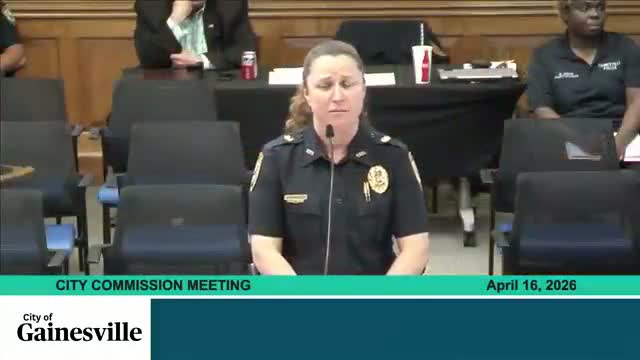
The Gainesville Police Department presented an extensive review on April 16 of the city's towing and vehicle-immobilization rules, citing inefficiencies, inconsistent documentation, and a surge in immobilizations. Major Kernick and tow administrator Monica Jordan urged clearer ordinance language, standardized photo documentation, two-year driver/operator permits, and authority to revoke permits for repeated violations.
GPD data in the presentation showed a marked shift from trespass towing toward immobilization in recent months and emphasized the department's limited ability to address consumer complaints without more detailed ordinance language and enforceable documentation standards.
The department offered three broad options for trespass towing: (1) eliminate roam towing entirely so property owners must call a tow operator for each incident; (2) permit limited roam towing (for instance, multifamily properties during nighttime hours) similar to Tallahassee's model; or (3) retain roam towing but update the ordinance with stronger documentation, signage, driver qualifications and permit rules. For immobilization (boots), staff recommended either eliminating it or amending the ordinance to mirror towing safeguards (daily logs, photo standards, contract requirements and a defined release timeline).
Public commenters — including residents, business owners and tow operators — gave sharply divergent views. Several consumer-advocates urged an outright ban on roam towing and immobilization, citing predatory practices and hidden signs; tow operators argued proposed operational time limits and joint liability rules would be unrealistically punitive and urged protections for business operations. A number of property owners told staff they rely on enforcement tools to keep parking available to tenants and customers; others said they prefer towing to immobilization because it frees the spot.
On motions, the commission directed staff to return a fee resolution that mirrors Alachua County where applicable and to set a maximum mobilization (boot) fee of $65 (inclusive of other charges) to be included in the resolution. That direction passed unanimously with one commissioner absent. The commission also directed staff to return with two ordinance-option packages for further consideration: a version that eliminates roam towing and immobilization and a second that retains limited roam towing (Tallahassee-style multifamily/night model) plus staff-proposed ordinance cleanups and consumer protections. Commissioners asked staff to perform outreach to property owners and tow vendors and to expedite the return of drafts so the commission can consider changes promptly.
Staff emphasized that many operational fixes are procedural (daily logs, CitizenServe contract uploads, consistent photo evidence) and recommended aligning business hours and driver-qualification rules with state practice. They also asked the commission to set mobilization and towing fees by resolution to remove ambiguity; commissioners voted that direction.
The commission's action does not itself change ordinance language; staff and the city attorney will prepare draft ordinances and the fee resolution for future readings after targeted stakeholder outreach.