Get Full Government Meeting Transcripts, Videos, & Alerts Forever!
Get email alerts on the Sdc Deferral Lookback topic
No spam. Unsubscribe anytime.
Commission debates short‑term SDC payment option and reverts look‑back to 'most intensive use' to 1997
Summary
City staff proposed adding a short‑term SDC payment option (delay to final trade inspections) alongside the existing 10‑year bankroft; commissioners asked whether it should apply to all development or be targeted to smaller housing, and directed staff to return with both options. The commission agreed to return the SDC reduction look‑back to a 'most intensive use' standard back to 1997 with the applicant bearing the burden of proof.
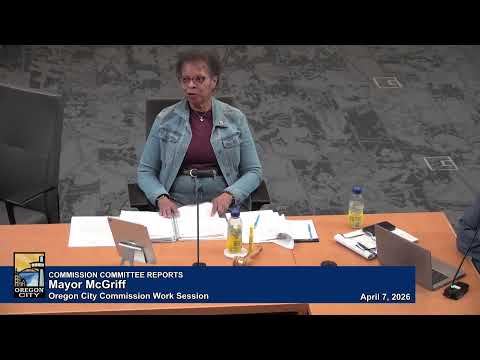
At the April 7 work session, Oregon City staff proposed two code changes related to systems development charges: (1) a short‑term payment option that delays SDC payment until final trade inspections (with conversion to the city’s existing 10‑year deferred payment/bankroft if needed), and (2) revising the SDC reduction look‑back to favor the "most intensive use" standard.
Dana Webb, public works director, told commissioners the city’s current long‑term deferral is administered as a bankroft agreement with a 10‑year term and a 9% interest rate; staff proposed adding a modest administrative fee and a short‑term option that would allow building permits to proceed while SDCs would be collected prior to final trade inspections rather than at permit issuance. Webb said finance would administer the short‑term approach and that temporary and final occupancy would be blocked without payment or coordination to convert the account to the long‑term plan.
Commissioners debated whether the short‑term option should apply to all development or be targeted to specific housing types. Some commissioners favored applying it broadly for simplicity and to help builders with construction financing; others urged targeting—suggesting small homes or owner‑occupied units—so the tool supports the city’s housing goals. Staff was directed to return with two options: one with a stated cutoff/targeting mechanism and one applicable across the board.
On SDC reduction look‑backs, staff reviewed the city’s history: the city previously used 'most intensive use' with a short look‑back, moved in 2014 to a 'most recent structure/use' with an 8‑year rolling look‑back, and later adopted fixed dates (2000 aerials for nonresidential, 1994 aerials for residential) to ensure administrability. Commissioners expressed concern that relying only on a most recent use can discourage redevelopment when prior low‑intensity uses yield large incremental SDCs. After discussion, the commission directed staff to revert to a 'most intensive use' standard with a look‑back to 1997 and said the burden of proof for historical use documentation should be on the applicant.
Other clarifications included examples staff provided about how the city would handle undocumented ADUs (where unpermitted conversions would be charged under current rules) and the practical limits of retrieving records from retired permitting systems. Staff noted some records prior to 1997 are incomplete and recommended placing the documentation burden on applicants seeking a historic, more favorable credit.
Why it matters: The short‑term payment option changes the timing of when the city collects SDC revenue and could reduce up‑front financing needs for builders; the look‑back change alters whether a redevelopment project receives a credit for prior uses, potentially changing the economics of reusing existing buildings.
Next steps: Staff will draft code language and return with two short‑term deferral options (targeted and universal) for a future business meeting; staff will also prepare language implementing the 'most intensive use' look‑back to 1997 and a requirement that applicants supply evidence to claim a historic credit.