Get Full Government Meeting Transcripts, Videos, & Alerts Forever!
Get email alerts on the Code Enforcement topic
No spam. Unsubscribe anytime.
Hope Mills staff outline code-enforcement process as residents press for tougher fines, more officers
Summary
Town planners and code officers presented the code-enforcement process, explaining inspections, notices, citations and abatement; residents and commissioners urged stronger enforcement, clearer towing rules and additional staff to address junk vehicles and litter at commercial gateways.
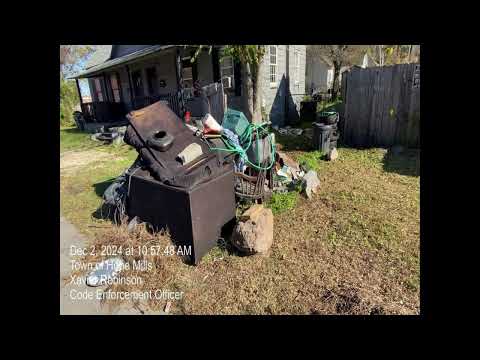
Xavier Robertson, the town planner, explained the Town of Hope Mills' code-enforcement mission and routine procedures, saying the office seeks voluntary compliance first and uses notices, citations and, when necessary, town abatement to correct violations. "The primary purpose is to protect public health and safety, preserve property values, reduce blight and neighborhood decline," Robertson said.
Robertson walked the board through how cases begin — usually a citizen complaint, online report or officer observation — followed by inspection, a notice of violation, a compliance period and a follow-up inspection. If violations persist, staff may issue citations or arrange town abatement and invoice the property owner, Robertson said.
Residents asked detailed questions about how the town handles specific problems. In response to a question about a fire-damaged, unoccupied house, Robertson said options depend on the extent of damage and whether a structure can safely be secured; staff will work with owners and insurers and follow up with timelines where possible. On fences, Robertson advised residents to obtain a zoning permit and request an inspection after construction is complete.
Board members pressed staff about abandoned and inoperable vehicles. Robertson said a vehicle is classified as a junk vehicle only when two qualifying defects are present — for example, flat tires and expired registration — and that vehicles blocking a street are referred to the police department for removal. He described the town practice of placing an orange sticker on a vehicle's windshield and knocking on doors to notify owners before towing.
The meeting included a lengthy exchange on fines, liens and collections. Robertson and Emily Wire, planning director, described an enforcement and collections process that includes issuing invoices to property owners, turning unpaid accounts to collections after 30 days and using liens in some cases. Wire and other staff said state statutory limits govern some fines, and the town recently improved administrative procedures to pursue unpaid abatement invoices more aggressively.
Several commissioners urged the board to explore adding code-enforcement officers. "We've had two code enforcement officers for 11 years," one commissioner said, arguing that staff increases would allow separate residential and commercial enforcement and more frequent patrols. Staff agreed to research statutory limits on fines and to return with options that could include signage, staffing changes or fee-schedule adjustments.
Clara Hines, a code enforcement officer, said the town had contacted Walgreens corporate on a problem hill near the store; corporate had come out to clean the site. Commissioners and residents discussed placing no-littering signage in DOT right-of-way and a trial sign between Walgreens and McDonald's as a low-cost deterrent while exploring longer-term gateway beautification options.
The board did not take formal action to change fines at the special meeting but asked staff to verify whether statutory limits constrain local fine increases and to return with options for stronger enforcement or additional staffing.