Get Full Government Meeting Transcripts, Videos, & Alerts Forever!
Get email alerts on the Utilities topic
No spam. Unsubscribe anytime.
Longwood to tighten oversight after repeated fiber work damages water infrastructure
Summary
After a series of underground utility strikes tied to recent fiber installations, Longwood commissioners pressed staff for stronger locates, valve preparedness and possible financial remedies; staff named Breakpoint as a third‑party locator and outlined plans to exercise and test valves to reduce future disruptions.
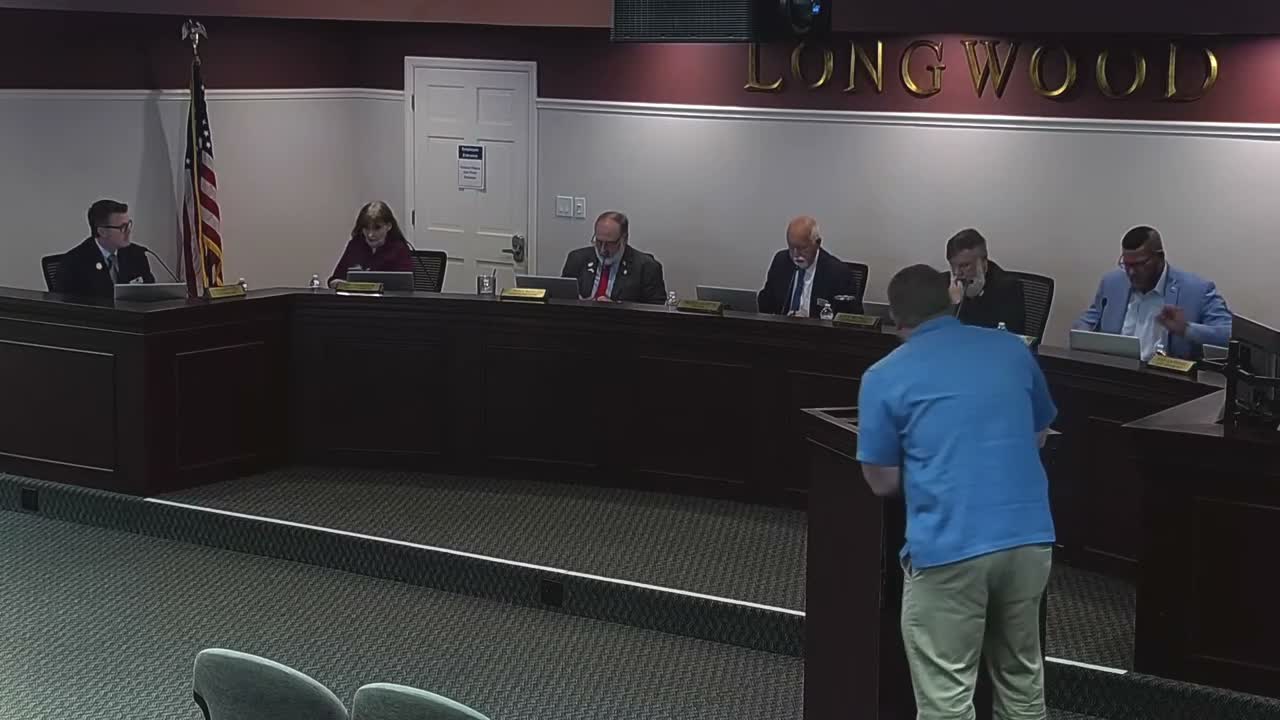
Longwood commissioners and staff spent much of their April 20 meeting focused on repeated underground utility strikes tied to recent fiber‑optic work, with the city manager saying the city has documented 12 incidents so far in 2026 and three significant strikes that prompted stop‑work orders.
“We've had 12 incidents involving underground utility strikes by the communication contractors,” City Manager Will told the commission, adding that three were significant and all three resulted in stop‑work orders and follow‑up meetings with staff.
Why it matters: the strikes have caused service outages and, in one neighborhood, a broken water main that left residents without water for hours and required multiple crews to respond. Commissioners and residents said those consequences made stronger oversight and clearer contractor accountability urgent.
At the meeting, commissioners pressed staff on oversight, enforcement and whether the city can use its authority as both a regulator and a utility owner to prevent future damage. Commissioner McMillan urged the city attorney to explore alternative legal angles such as easement encroachment and foreseeability — the idea that repeated problems make future strikes more predictable and therefore more preventable.
City Manager Will outlined two immediate strategies staff will pursue: first, preparedness—proactively exercising and verifying the operational status of critical water valves in areas scheduled for undergrounding so crews can shut water off quickly if a main is struck; and second, strengthening long‑term valve maintenance, budgeting to test valves systemwide twice a year and documenting valve status so response is faster during emergencies.
“Where we know underground work is planned, we will assess the maps, we will assess the locates, and we will ensure that the depths are followed in accordance to the information that we know,” Will said.
Legal limits and options: City Attorney Dan (last name not stated) said state law preempts some local regulation of telecom installations but noted Longwood already has stronger local rules than many cities, including stop‑work authority and permit revocation when conditions are violated. He also recommended the commission and staff evaluate targeted rule changes—such as requiring additional measures in areas with aging infrastructure—while acknowledging such changes could draw lobbying pushback from telecom companies.
Dan said the legislature “required that all cities allow without charging a fee for telecom companies to be able to install fiber and wireless communication facilities on a right of way,” and cautioned there are limits on how far the city can go in restricting where and how those companies operate.
Contracting and locates: Staff told the commission that Wow (the communication company performing undergrounding work) had contracted a third‑party locating firm called Breakpoint; commissioners noted instances where Breakpoint’s paint markings were off (one commissioner said the locate was “two feet off” a gas main), and asked staff to identify whether systemic errors occurred across neighborhoods.
Potential remedies: Commissioners discussed financial penalties, civil claims to recover lost utility revenue, and stricter permit conditions that could force telecom contractors to pay more up front or to meet additional locating standards. City Attorney Dan said civil claims for damages likely exist, but pursuing litigation may not always be cost effective.
Next steps: Staff and the city attorney said they will review the meeting record and coordinate to present options to the commission, including stronger permit requirements for projects near known water and sewer lines, more stringent locate verification, and financial remedies where permitted by law.
The city manager said staff will also immediately begin valve‑exercise efforts and continue stop‑work order meetings after major incidents to capture lessons learned.
The discussion closed with commissioners urging staff to return with concrete regulatory and legal options for reducing future risk and improving contractor accountability.