Get Full Government Meeting Transcripts, Videos, & Alerts Forever!
Get email alerts on the Cannabis Ordinance topic
No spam. Unsubscribe anytime.
Lengthy public hearing on cannabis rules ends without decision; board asks staff for mapping and science-based odor options
Summary
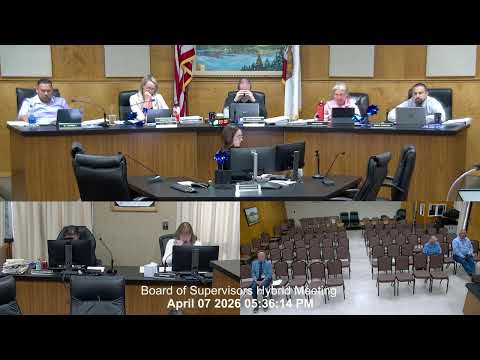
After hours of testimony from supervisors, staff, growers and residents, the Board of Supervisors did not adopt ordinance changes but directed staff to return May 12 with GIS mapping of potentially nonconforming permits, analysis of setbacks by zoning, and recommended odor‑mitigation performance standards.
The Board of Supervisors heard several hours of testimony on proposed amendments to Article 27 (commercial cannabis) and related code changes, but took no final action. The hearing covered reduced‑canopy and opt‑out rules, inspection and annual reporting, retail permitting in commercial zones, farmland-protection-zone boundaries, and odor‑mitigation approaches including Yolo County-style odor‑management plans and setback alternatives.
Staff advised the board on a menu of options—ranging from larger fixed setbacks (the packet used 200 feet as current minimum and presented 1,000‑foot as a potential maximum) to performance-based odor plans that rely on professional wind and odor modeling. "There are a number of criteria that could be implemented to help mitigate and minimize odor impacts," staff said, listing site selection, prevailing‑wind analysis, vegetative buffers and waste management.
Growers and farm advocates urged the board to treat cannabis as agriculture, warning that aggressive setbacks would convert some approved projects into nonconforming uses, reduce plantable acreage and risk driving investment out of the county. "Changing the rules after the fact reduces plantable acreage and places an unfair burden on farmers who have already complied," said grower representatives.
Opposing residents and other commenters urged stricter setbacks, stronger odor mitigation and even acreage caps for commercial grows; some cited recent state and county litigation and class‑action risks related to persistent odors. Neighbors described repeated strong odor events from nearby permitted and unpermitted operations and asked for enforceable remedies.
After extensive discussion, the board directed staff to return on May 12 at 1 p.m. with GIS mapping showing which existing permits would become nonconforming under candidate setback choices (to inform whether a thousand‑foot setback was feasible), recommended minimum thresholds for reduced‑canopy years (the tax collector/treasurer was asked to advise on an administrable threshold), and options that pair setback distances with performance-based odor plans and enforcement mechanisms. The board did not adopt any ordinance amendments at this meeting.