Get Full Government Meeting Transcripts, Videos, & Alerts Forever!
Get email alerts on the Sanitation Budget topic
No spam. Unsubscribe anytime.
Philadelphia seeks $190 million for sanitation in FY27, aims to institutionalize Clean & Green programs
Summary
City sanitation officials told City Council the FY27 budget request would stabilize and scale proven Clean & Green initiatives — including Future Track workforce placements, twice-weekly collection expansions and illegal-dumping crews — while funding pilots to increase recycling and organics diversion.
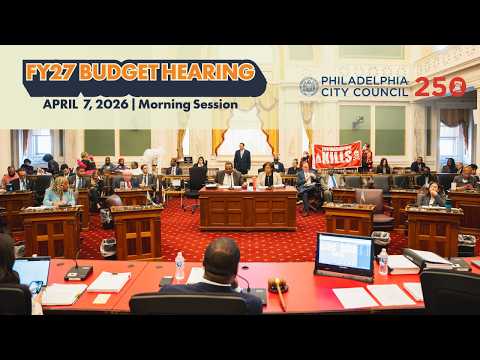
Philadelphia sanitation leaders asked City Council Wednesday to approve a FY27 operating budget that they say will convert recent pilots into permanent, citywide services while investing in enforcement and waste-diversion pilots.
Carlton Williams, director of the Office of Clean and Green, told the Committee of the Whole the administration’s FY27 request “marks a pivot from building and implementing multiple new and expanding clean and green initiatives to sustained transformation of city conditions going forward.” Williams cited what he described as measurable gains from recent years: “During fiscal year 2026 alone, over a dozen government and quasi government agencies worked together to clean 20,000 streets and address more than 150,000 quality of life actions across the city.” He also said twice-weekly trash collections have driven a roughly 15% reduction in illegal-dumping calls in the neighborhoods where it has been expanded.
The sanitation commissioner, Crystal Jacob Shipman, said the department’s FY27 general-fund request includes $190 million with $22.2 million in all-funds appropriations for department operations. Shipman outlined operational investments the budget would support, including six dedicated illegal-dumping cleanup crews, expanded camera surveillance and enforcement staff, and resources to operate the recently rehabilitated Northwest Transfer Station.
Shipman also detailed recycling and diversion targets. She said recycling participation has risen from a pandemic low of 8% (FY21) to an expected 14% this year, with a FY27 goal of 15%. The administration plans to continue expanding compacting public receptacles (Big Belly units), with an expected network of about 1,500 units citywide once new installations are complete.
Workforce development remained central to the testimony. Williams and Shipman said the Philly Future Track program has transitioned more than 260 participants into permanent civil-service positions over recent years and that the FY27 budget sustains a 200-trainee annual cohort. Williams said sustaining the pipeline is central to staffing gains in sanitation and related services.
Council members pressed officials for staffing details. Deputy Commissioner Christopher Newman said the department is ‘‘continuously in a hiring mode’’ and recently hired more than 300 workers this year, with roughly 100 of those through Future Track. Shipman said the department is budgeting for 76 sweep officers focused on recycling education and enforcement, with 54 positions filled at the time of testimony.
Officials also described several neighborhood-focused pilot efforts included in the request: an organics collection pilot and an RFI to solicit private partners for large-scale organics processing; a Lotscapes program to formalize community-driven lot restorations and gardens; and continued investments in bulk collection and sanitation convenience centers.
The hearing continues with council members and administration staff set to work through budget detail and related procurement questions. No formal vote was taken Wednesday; the council will consider the FY27 budget through its regular committee process.