Get Full Government Meeting Transcripts, Videos, & Alerts Forever!
Get email alerts on the Traffic Calming topic
No spam. Unsubscribe anytime.
Residents oppose NDOT speed cushions on Lone Oak Road; agency offers lane‑narrowing and delineators as alternatives
Summary
At a March 2 NDOT neighborhood meeting, engineer David Greavves presented a preliminary plan of five speed cushions for Lone Oak Road. Several residents said they oppose cushions and prefer enforcement, refreshed striping, or visual narrowing; NDOT outlined a six‑week online ballot requiring a two‑thirds yes vote to proceed.
David Greavves, a civil engineer with the Nashville Department of Transportation, told neighbors at a March 2 virtual meeting that NDOT has proposed a preliminary traffic‑calming design for a short segment of Lone Oak Road that would place five speed cushions spaced roughly 300–500 feet apart to target speeds near 25–30 miles per hour. Greavves emphasized the design is preliminary, subject to change and property‑owner approval.
The proposal drew swift pushback from residents. “I don't think any of us on this call ... want to see any speed bumps,” one resident said, adding neighbors would prefer greater enforcement and refreshed pavement striping rather than vertical measures. Other attendees raised similar concerns about noise and livability: a resident who lives adjacent to the middle proposed cushion asked whether the cushions would wake people at night and said the proposed cushion would be “right outside my bedroom window.” Greavves said national studies show modest sound from cushions and that, overall, cushions tend to reduce loud episodic behavior such as drag racing, but he acknowledged cushions are not silent.
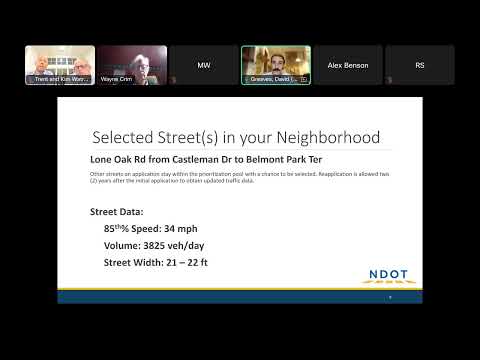
NDOT staff reviewed the program rationale and data that led to the selection. Greavves said Lone Oak recorded about 3,800 vehicles per day during NDOT counts and an 85th‑percentile speed of about 34 mph; he also noted the roadway width is roughly 21–22 feet, which constrains some design options. The agency framed traffic calming around the “three E’s” — education, enforcement and engineering — and said engineering changes offer the most consistent speed reductions.
Several residents suggested alternatives that avoid vertical measures. One longtime neighborhood resident suggested visual narrowing — for example, refreshed edge striping and flexible delineators on the centerline near curves — to make the road feel narrower and slow drivers without cushions. Multiple speakers said they would prefer stepped‑up enforcement by Metro Nashville Police Department over speed cushions.
Greavves described next steps: NDOT will refine a design (he said staff will consider a cushionless option featuring lane‑narrowing and delineators), post plans online and open an online ballot for property owners in the project’s ballot zone. He said ballots are sent to parcels whose lines touch the right‑of‑way (residences, churches, schools) and that the program requires two‑thirds (66%) of respondents to vote yes within a six‑week ballot window for construction to proceed; Greavves added that, if approved, projects typically enter an 8–10 month construction queue before field work begins.
Residents also raised process questions: why the project limits stop at Belmont Park Terrace rather than continuing farther along Lone Oak, whether non‑residents can apply and how ballots are tied to tax parcels. Greavves said applications normally come from an HOA, neighborhood association, council member or a small group of residents and acknowledged staff had encountered confusion about this project’s applicant record; he said NDOT would review parcel lists and follow up to ensure eligible owners receive ballots.
Greavves asked for additional feedback by email and the city’s online engagement form and said NDOT will post a revised design for further review. The meeting closed with staff thanking attendees and promising follow‑up on the QR code/project list glitch one resident flagged.