Get Full Government Meeting Transcripts, Videos, & Alerts Forever!
Get email alerts on the Cargo Inspection Penalties topic
No spam. Unsubscribe anytime.
Guam committee reviews bill to tighten cargo inspections, raise seal-tampering penalties
Summary
Bill 270-38 would require customs-held containers to remain in designated secured facilities, mandate stronger seals and raise penalties for seal tampering to $100,000 or the cargo value; Customs and Quarantine Agency (CQA) backed the update while residents urged protections for small importers.
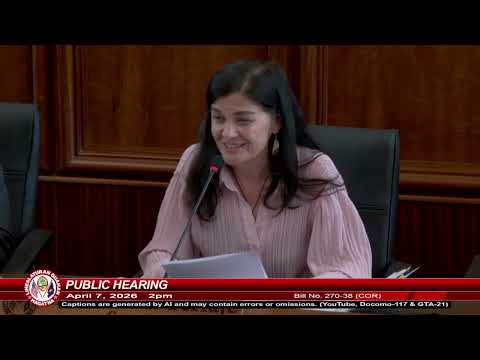
Senators heard testimony on April 7, 2026 on Bill 270-38, legislation that would update Guam law and administrative rules to strengthen inspection of incoming cargo, increase penalties for seal tampering and clarify where and how inspections may take place.
The bill’s author, Senator Theresa Talai, told the Committee on Transportation, Tourism, Customs, Utilities, and Federal and Foreign Affairs that she introduced the measure after oversight raised concerns about broken seals and the risk of drug trafficking. Talai said the measure would keep containers under customs hold in designated secured facilities, "increase the fine for seal tampering from $25,000 to $100,000 or an amount equal to the value of the cargo, whichever is greater," and preserve business-license suspension while allowing a written waiver by the director in specified circumstances.
"We are currently faced with the meth crisis in Guam," Talai said, arguing the changes would deter tampering and help prevent contraband, invasive species and other risks that travel in commercial shipments.
Customs and Quarantine Agency Director Ike Pedo told the committee the agency supports the bill’s intent, calling the updates "necessary to address import volumes, modernize trade facilitation, and strengthen security and integrity of customs procedures." Pedo said CQA submitted proposed amendments to clarify operational details and to make the statutory language match modern shipping practice.
During questions, committee members flagged fiscal and operational uncertainties. A briefing note from the Bureau of Budget and Management Research (BBMR) said it had not received final input from CQA and could not determine the cost impact of a CQA-designated secured facility; committee members requested clearer cost estimates tied to facility location, square footage and security infrastructure.
Members of the public and small-business representatives largely supported stronger inspection authority but asked for protections. Longtime resident and small-business owner Sedree Lin Sangan said she supported the bill’s aims "but with exemption[s]," warning the jump "from $25,000 to $100,000" could bankrupt small importers and urging that investigators examine each case before imposing stiff penalties.
Pedo and CQA leaders described the agency’s current enforcement practice and statistics. The director said nine assessed seal-tampering penalties that were reviewed during his term had been paid; he and CQA staff said their investigations classify most incidents as negligence or handling errors rather than deliberate tampering. "My review of the nine reports that I’ve reviewed, it was negligence on their part," one senior official said.
CQA also provided counts for port-discharge seal discrepancies that the maritime/inspection units track: for calendar year 2024, agency staff reported 57 missing seals, 41 broken seals, two improper seals and two seals placed on the wrong door (102 total); for 2025 staff reported 53 missing seals, 30 broken seals and other small categories (91 total); and for 2026 to date they reported three missing seals and one broken seal.
Committee members pressed CQA on operational options for inspections. Officials described three approaches: ground containers at the port (a special service request with port fees), move them to a registered Container Freight Station (CFS) — CQA cited typical CFS costs of about $1,500–$2,000 per 40-foot container — or permit inspection at a provisional inspection site (CQ30) that meets agency criteria. CQA recommended updating the statute and regulations to require ISO-certified bolt (high-security) seals for containers flagged for customs inspection.
On enforcement discretion, CQA recommended keeping a director-level waiver process so suspending a business license is not automatic in every case. CQA officials said confiscation and license revocation remain options when an inspection uncovers contraband; according to the agency’s summary of recent cases, the nine incidents cited earlier did not yield contraband and were handled as administrative violations.
Officials confirmed that CQA coordinates secondary screening and referrals with U.S. Customs and Border Protection, Homeland Security Investigations, Drug Enforcement Administration, FBI and the U.S. Coast Guard when law-enforcement leads require interagency action.
The committee left the record open for written testimony for 10 days following the hearing. Senator Jesse A. Luhan adjourned the hearing at 3:17 p.m.
The committee is expected to consider sponsor and agency markups before any final vote; BBMR and committee members asked CQA to provide clearer cost estimates and written criteria for provisional-site exceptions or waivers to ensure consistent application.