Get Full Government Meeting Transcripts, Videos, & Alerts Forever!
Get email alerts on the Medicare No Fault Fee Schedule topic
No spam. Unsubscribe anytime.
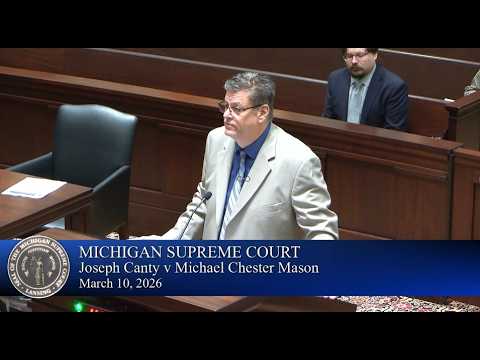
Court hears arguments in Kanty v. Mason over Medicare opt‑out and no‑fault fee schedule
Summary
Counsel disputed whether Michigan's no‑fault fee schedule (cited as MCL50031572) applies to third‑party tort damages when a plaintiff has "opted out" and whether plaintiffs must use Medicare to mitigate damages; the court submitted the case for decision.
The court heard oral argument in Kanty v. Mason over whether Michigan's no‑fault fee schedule applies to third‑party tort claims when a plaintiff has "opted out" of personal protection insurance and whether plaintiffs who opt out must use Medicare to mitigate damages.
Plaintiff counsel, Mr. Stone, argued that his client had "opted out," so PIP and the fee schedule under MCL50031572 do not apply to the third‑party tort claim. "If you opt out of something, you're done," he told the court, saying the statute's fee schedule language applies only to personal protection insurance and not to third‑party liability actions.
Michael Cook, attorney for the defendant Michael Mason, countered that the legislature intended Medicare (Parts A and B) to be a prerequisite to the opt‑out regime for allowable expenses and that requiring plaintiffs to use Medicare helps avoid the delays and payment uncertainty prior law produced. Cook said the fee schedule is incorporated into the scheme governing "allowable expenses" and that failing to require mitigation through Medicare would create "a trap for the unwary." "That trap disappears if the plan mitigates their damages in the way I think the legislature plainly intended, using their Medicare," he said.
Justices pressed both sides on how conditional Medicare payments and asserted liens would interact with tort recovery and on whether a plaintiff who seeks care from a provider that does not bill Medicare can nevertheless recover full billed charges. One justice asked a numerical hypothetic (a $50 provider and a $75 provider) to test whether the plaintiff would be obliged to submit claims to Medicare and whether failure to do so would affect the amount recoverable. Counsel and the bench discussed the collateral‑source rules, the effect of a Medicare lien, and precedent framing damages as the "amount actually paid" in some contexts (counsel cited McCauley and related authority).
Both sides acknowledged factual questions remain for the lower court on which providers actually billed Medicare, whether submissions were made and rejected, and whether non‑Medicare providers' charges were reasonable and necessary. Defense counsel argued some of those matters must be developed at the record level before summary disposition.
The parties also debated statutory text and structure: plaintiff urged a textual reading that the fee schedule applies to PIP only; defense urged that the legislature incorporated the fee schedule into "allowable expenses" across the amended provisions and that drafting choices show intent to contain costs. Counsel referenced the 2019 no‑fault reforms repeatedly as the policy backdrop.
The court took the case under advisement, stating it would "submit" the case, and then adjourned. No decision or vote was announced.
What happens next: The court will issue an opinion after deliberation. That opinion will determine whether plaintiffs who opt out must use Medicare to mitigate allowable expenses and whether the statutory fee schedule applies in third‑party tort suits under the current no‑fault framework.