Get Full Government Meeting Transcripts, Videos, & Alerts Forever!
Get email alerts on the Surveillance Reform topic
No spam. Unsubscribe anytime.
Lawmaker urges Senate to reject General Rudd, calls for sweeping surveillance reforms
Summary
A senator urged colleagues to oppose General Rudd’s nomination to lead the NSA and Cyber Command, citing failures to commit to limits on warrantless surveillance and to disclose policy violations, and laid out a bipartisan plan to reform Section 702, bar government purchases of location and web-browsing data, and limit AI-driven profiling.
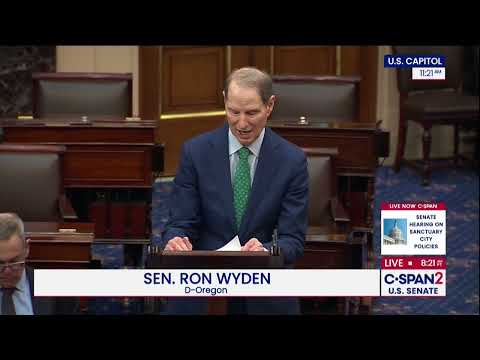
A member of the Senate spoke on the floor to oppose the nomination of General Rudd to lead the National Security Agency and U.S. Cyber Command, saying the nominee failed to show a minimal understanding of constitutional limits on surveillance and refused to promise transparency about possible policy violations.
The lawmaker said General Rudd "failed to demonstrate a bare-minimum understanding of the constitutional limits on NSA activities" and would not commit to the agency's past policy against buying and using very sensitive location data on Americans. The speaker urged colleagues to oppose the nomination unless senators secure stronger statutory protections against surveillance abuse.
The senator framed the nomination in the context of a larger push to overhaul surveillance law. The speech previewed three issues to come before the Senate: reauthorization of Section 702 of the Foreign Intelligence Surveillance Act, agency surveillance of Americans by Immigration and Customs Enforcement, and the ways artificial intelligence can be used to surveil U.S. persons.
About Section 702, the lawmaker explained it authorizes a warrantless surveillance program that is approved at the program level by the Foreign Intelligence Surveillance Court while individual target selection remains a matter for the government. Citing public data, the speaker said "there were more than 291,000 targets" in 2024 and warned that many of those targets communicate with Americans, producing large incidental collection of U.S. persons' communications.
The senator criticized the typical reauthorization process as rushed and secret, saying it often produces inadequate bills presented just before expiration and leaves little time for senators to consider amendments on the merits. "Senators should not accept secret interpretations of the legislation they vote on," the lawmaker said, urging an open debate.
The speaker singled out a reauthorization change that delegated approval for certain "especially sensitive" searches—including searches that could touch elected officials, appointees, political organizations and journalists—to the deputy FBI director. The transcript named the prior deputy director (noted in the speech) and identified Andrew Bailey as the replacement; the lawmaker characterized both appointments as politically fraught and said the FBI has refused to keep a straightforward record of those sensitive searches despite Inspector General recommendations.
On another track, the senator described a House change that could allow the government to compel individuals with access to communications equipment—such as installers or repair technicians—to collect communications for the government, saying the expansion "could mean anybody installing or repairing a cable box" might be forced to collect communications and that the provision must be repealed.
The speech detailed agencies' commercial purchases of sensitive data. The senator said multiple agencies—including Immigration and Customs Enforcement, Customs and Border Protection, the Pentagon, the Internal Revenue Service and the FBI—have purchased location and web-browsing records from data brokers, and that the government bought records of millions of Americans' movements without warrants. The lawmaker said a program shut down in 2023 was later reported to have resumed and accused ICE of stonewalling oversight requests.
Warning about new risks posed by artificial intelligence, the speaker said AI tools can comb vast purchased datasets to identify patterns and create behavioral profiles, calling such profiling "a chilling expansion of mass surveillance that must not be allowed." The lawmaker cited a recent case in which the administration publicly pressured a company whose CEO refused to permit an AI tool to be used for mass surveillance.
To address these risks, the senator said a bipartisan, bicameral Government Surveillance Reform Act will be introduced this week to enact reforms to Section 702, to prohibit or sharply restrict agency purchases of sensitive location and browsing data from data brokers, and to limit AI-enabled profiling of Americans using such data. The senator emphasized attaching these reforms to any 702 reauthorization to avoid piecemeal fixes.
The speech closed with a renewed call to oppose General Rudd's nomination unless the nominee commits to respecting limits on warrantless surveillance and to transparency about policy violations; the lawmaker said they would consult colleagues and press for the bill's introduction.
The senator did not put forward a formal motion or vote during the remarks; next steps identified were the introduction of the Government Surveillance Reform Act and continued floor debate and consultation among senators.