Get Full Government Meeting Transcripts, Videos, & Alerts Forever!
Get email alerts on the Housing Policy topic
No spam. Unsubscribe anytime.
Tempe Housing Authority adopts FY 2026–27 annual plan, approves administrative policy changes
Summary
The Tempe Housing Authority governing board voted unanimously to adopt its FY 2026–27 PHA annual plan and related administrative revisions, after a quarterly performance update showed more than $18 million in budget authority and roughly 1,030 vouchers leased. The vote was 8–0.
Tempe — The Tempe Housing Authority governing board voted unanimously to adopt its fiscal year 2026–27 Public Housing Agency annual plan and related certifications, and approved revisions to the agency’s administrative policies that expand project-based voucher contract terms and clarify program oversight.
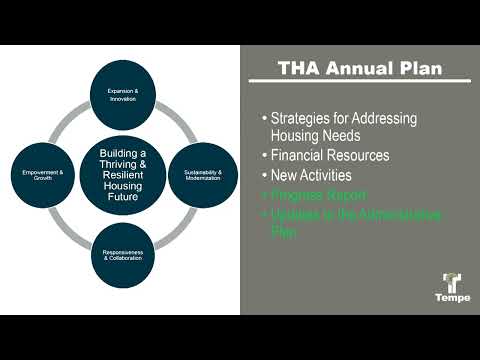
Irma Holland Bain, deputy human services director for housing, told the board the authority is “on track to administer over 18 million in housing subsidy” and has “capacity to assist 1,234 households.” She reported that 1,030 vouchers are currently leased and cited a 7.60% attrition rate. Bain said the authority is using 100.26% of its budget authority as of December 2025 and read figures displayed on the presentation slides (the slides quoted an “average per-unit cost” as “1520.38 cents”).
The board held a public hearing on the annual plan; no members of the public spoke. Board member Hajj moved adoption of the plan; board member Anberg seconded. The board approved the resolution by roll call, with all eight members voting yes.
The adopted package includes several administrative-plan changes Bain described at the meeting. Staff removed references to HUD guidance in the housing authority’s language-assistance materials while retaining the requirement to provide meaningful assistance under the Civil Rights Act of 1964, she said. The authority also updated procedures to ensure timely compliance with information requests and appointments.
On project-based vouchers (PBVs), Bain said the authority proposed lengthening the maximum contract term it will use with developers from 15 to 20 years and added oversight language for the PBV property waitlist. She also said the agency clarified termination-review and hearing procedures and added conduct-related language that allows staff to give verbal warnings and, in some cases, to reschedule or deny voucher business activity if behavior prevents safe, professional interactions.
Board members asked for more granular information about landlord participation and voucher distribution geography. Board member Hajj asked for counts of landlords in the agency’s “landlord promise” program and for ZIP-code–level breakdowns of voucher use; Bain said she did not have those numbers at the meeting and offered to follow up.
The board also approved routine minutes from its Jan. 22, 2026 meeting by unanimous vote before adjourning at 5:52 p.m.
What happens next: The adopted annual plan and related certifications position Tempe to implement the FY 2026–27 program year and to accept additional Housing Choice Vouchers if they become available from HUD. The authority indicated staff would provide follow-up data requested by board members.