Get Full Government Meeting Transcripts, Videos, & Alerts Forever!
Get email alerts on the Income Inequality topic
No spam. Unsubscribe anytime.
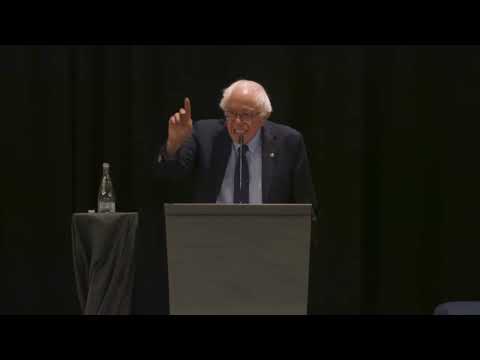
United States senator urges action on inequality, health care and affordable housing
Summary
A United States senator delivered a forceful address arguing that extreme wealth concentration and political influence are worsening hunger, homelessness and health-care gaps, and urged investment in affordable housing, universal health care and higher wages for child-care and teaching staff.
The United States senator told an audience that "in the richest country in the history of the world every man, woman and child in America should have a decent standard of living," and urged leaders to prioritize basic needs over tax breaks for the wealthy.
The senator framed the speech around rising income and wealth inequality, saying the country now has "never before" seen so few owning so much and asserting that "60% of our people are living paycheck to paycheck." He argued that wealthy donors and media ownership have shifted government priorities away from ordinary Americans and toward the top 1%.
The senator criticized current U.S. health-care outcomes, citing national spending of roughly $15,000 per person while asserting that about "85 million Americans" are uninsured or underinsured. "The function of a rational health care system is not to allow large pharmaceutical companies and insurance companies to make huge profits. It's to guarantee health care to all as a human right," he said.
Turning to housing, the senator said the country faces both homelessness and housing-cost pressure: "Today in America, we have not only 800,000 Americans who are homeless, we have 20 million households who are spending 50% or more of their limited incomes on housing." He proposed redirecting resources from large tax breaks for the wealthy toward creating "millions and millions of units of low-income and affordable housing."
On education and child care, the senator argued that child-care and Head Start workers and public-school teachers should receive living wages and benefits so the nation can attract and retain qualified staff, warning that poor pay undermines the quality of schools and early-childhood supports.
He also described poverty as a public-health problem, saying low-income Americans can expect shorter lives and that chronic stress from economic insecurity damages mental and physical health. The senator concluded by thanking social-service workers and pledging that he and colleagues in Congress would push for policies to ease the pressures faced by low-income families.
The remarks were delivered as a policy appeal rather than a formal legislative proposal; the senator did not introduce specific bills or motions during the address. The event ended with applause.