Get Full Government Meeting Transcripts, Videos, & Alerts Forever!
Get email alerts on the Zoning Change R1 topic
No spam. Unsubscribe anytime.
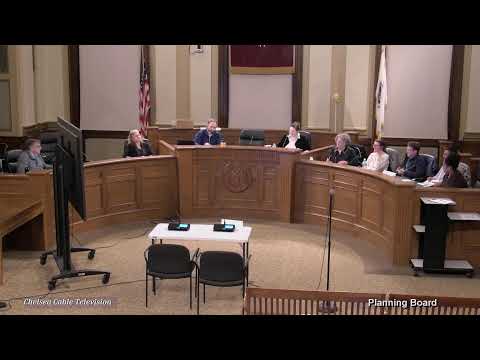
Planning Board declines to recommend R1 lot‑size reduction and three‑family allowance, cites neighborhood character and timing
Summary
The board voted 5–1–1 to recommend denial of a zoning amendment that would lower minimum R1 lot sizes from 7,500 to 5,000 sq ft, reduce lot area per unit, and allow three‑family dwellings by special permit; members cited historic character, ADU law interactions, and a need to coordinate with the master plan.
The Chelsea Planning Board voted to recommend denial of Zoning Amendment 26‑23, which proposed reducing minimum R1 lot sizes from 7,500 to 5,000 square feet, lowering the minimum lot area per unit from 3,500 to 3,000 square feet, and allowing three‑family dwellings in the R1 district by special permit.
Planning staff explained the proposal and presented parcel data: the R1 district contains roughly 1,900 parcels, of which about 1,000 are under 5,000 sq ft, roughly 500 fall between 5,000 and 7,500 sq ft, and just under 400 parcels are 7,500 sq ft or larger. Staff noted about 167 unimproved lots citywide (17 of which are ≥7,500 sq ft), and advised that a three‑family special‑permit standard would effectively require a 9,000‑sq‑ft minimum lot size for those structures. Staff also flagged that recent state law changes allow accessory dwelling units (ADUs) by right, which can affect unit counts and how much zoning change would change development outcomes in practice.
Board members raised multiple concerns during deliberations: protecting the low‑density and historic character of R1 neighborhoods, the absence of changes to the proposal since it previously came before the board, and the prudence of letting the state ADU law and an impending master plan update play out before adopting substantial dimensional changes. Several members recommended splitting the proposal into separate elements (lot‑size reductions vs. allowing three‑families) or deferring any substantial change until a broader community engagement process and master‑plan implementation.
Public comment was divided. Giovanni Recupero (District 6 councilor) urged the board to approve the amendment, arguing Chelsea needs room to grow and criticizing what he described as unequal treatment between neighborhoods. Councilor Todd Taylor reiterated earlier testimony that the R1 district serves a distinct role and cautioned against making every neighborhood the same; other speakers urged caution and more study.
After further discussion, a motion to "not recommend approval" (i.e., recommend denial) of the amendment carried with a recorded 5‑1‑1 result (five board members in favor of recommending denial, one opposed, one abstention). The board’s recommendation is advisory; the full City Council will consider the amendment if and when it is placed on a Council agenda.
The Planning Board asked staff to continue monitoring ADU law impacts and suggested that policymakers consider any lot‑size or dimensional changes as part of the city’s broader master plan and zoning updates rather than as an isolated amendment.