Get Full Government Meeting Transcripts, Videos, & Alerts Forever!
Get email alerts on the Cdbg topic
No spam. Unsubscribe anytime.
Cathedral City council introduces FY 2026–27 CDBG action plan, selects two streets for reconstruction
Summary
Council introduced a draft FY 2026–27 Community Development Block Grant action plan estimating about $510,000 in federal funding and proposed using $48,000 of CDBG toward reconstruction of Avanita Elmundo and Avanita Al Pueblo, with SB1 funds to cover the remainder. Mayor Pro Tem disclosed residence in the project area and the city attorney cleared him from a conflict.
Cathedral City council opened a public hearing March 11 to introduce its draft fiscal year 2026–27 Community Development Block Grant (CDBG) annual action plan and to explain early project prioritization.
Elizabeth Medina, who presented the draft, said HUD allocations had not been published but staff estimated an allocation near $510,000 and proposed reserving up to 20% for administration and $48,000 toward a public improvement project: reconstruction of Avanita Elmundo and Avanita Al Pueblo from Macllum Way to Ramon Road. Medina said the construction estimate is roughly $1.2 million and staff proposes using SB1 funds to cover the remainder after the CDBG contribution.
“Using that $48,000 of the CDBG anticipated allocation, we have enough available SB1 funding to cover the remainder,” Medina said.
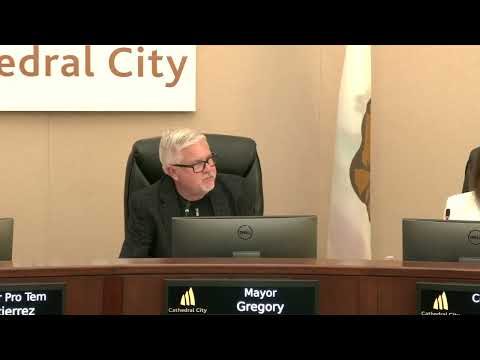
Mayor Pro Tem Tim Gutierrez disclosed on the record that he lives in District 4, where the proposed reconstruction would occur, and said he had consulted the city attorney. The city attorney advised the council that Fair Political Practices Commission regulation 18702.2 provides an exemption for maintenance and repair or replacement of existing facilities, and concluded this project—described as replacing and repairing an existing roadway without adding lanes or new services—did not create a disqualifying conflict.
“The project falls under the exemption and the council member doesn’t have a conflict of interest under the rules,” the city attorney said.
Council members pressed staff for more detail on how the two street segments were chosen. Public works staff explained they use the city’s pavement management plan and a pavement condition index (PCI) to prioritize work and then match projects to available funding sources. Council members asked for more transparent selection logic when multiple adjacent streets have similar PCI scores.
“We get down to that a lot of streets are equal,” a public works official said, adding staff considers past investments, available funding, and whether full reconstruction rather than piecemeal work is feasible for the amount available.
Medina outlined the schedule: a 30‑day public comment period beginning March 12, with a second public hearing and proposed approval planned for April 22 and a final action timed to meet HUD’s May 15 deadline for the annual plan.
What happens next: The draft plan will be posted for a 30‑day public comment period and brought back to council for a second hearing and final action once HUD formula allocations are published.