Get Full Government Meeting Transcripts, Videos, & Alerts Forever!
Get email alerts on the Civic Engagement Commissions topic
No spam. Unsubscribe anytime.
Seattle Office for Civil Rights commissions outline 2026 priorities on housing, safety and access
Summary
Four advisory commissions supported by Seattle's Office for Civil Rights—the Human Rights, Women's, LGBTQ and Disability commissions—presented 2026 work plans emphasizing housing and homelessness, gender-based violence prevention, a community navigator for trans arrivals, accessibility projects and cross-departmental coordination.
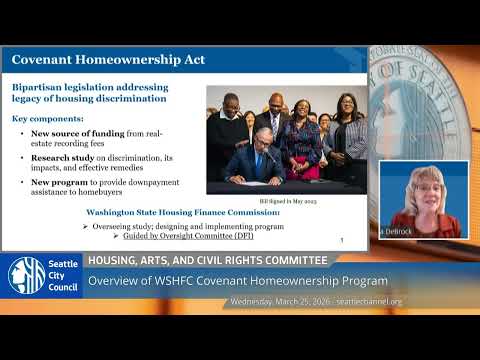
The Seattle Office for Civil Rights presented work plans March 25 to the City Council's Housing, Arts and Civil Rights Committee, with chairs and co-chairs from four advisory commissions outlining priorities for 2026.
Meredith Stone, commissions manager at the Office for Civil Rights, introduced the Human Rights, Women's, LGBTQ and Disability commissions and said commissioners are volunteers who partner with city departments and community organizations. Gwen McCullough, chair of the Seattle Human Rights Commission, described task forces focused on housing and homelessness, criminal legal system reform and anti-human trafficking; she said the commission launched a new Policy Review Committee to advise the Office for Civil Rights on city policies that could result in discrimination.
Emily Rose Barr and Whitney Nakamura, co-chairs of the Seattle Women's Commission, emphasized three priority areas: preventing and responding to gender-based violence, advancing housing stability for women and families, and addressing women's health and wellness. Barr said the commission plans a tailored "Fair Housing Laws Guide" for single women and families and is working on an amendment to address survivors of financial abuse.
LGBTQ co-chairs Kody Allen and Jessa outlined pillars of intersectional advocacy, community empowerment and commission sustainability. Allen said the commission intends to build a community navigator program to connect trans and queer arrivals'including asylum-seekers and refugees'to existing city services and community supports, explaining many new arrivals arrive without clear pathways to assistance.
Bianca Gallegos and Scot Nelson described the Seattle Disability Commission's recent growth and accomplishments, including expanding membership, a wheelchair charging-station rollout and advocacy for the Talking Book and Braille Library. Nelson highlighted partnerships with city departments on accessibility features for parks and transportation projects and said the commission will push for improved job security and housing access for people with disabilities.
Multiple councilmembers praised the commissioners'work and asked how the council can better support cross-departmental coordination. Councilmember Lin and others offered to help connect commissioners to department contacts; commissioners requested help reestablishing institutional relationships lost during staff turnover and the pandemic. Several councilmembers indicated they would follow up to pursue joint initiatives and data-sharing requests.
The committee adjourned after the presentations and Q&A.
Sources: Presentations and remarks by Meredith Stone, Gwen McCullough, Beverly Smith, Emily Rose Barr, Kody Allen, Jessa, Bianca Gallegos, and Scot Nelson during the March 25 committee meeting.