Get Full Government Meeting Transcripts, Videos, & Alerts Forever!
Get email alerts on the Zoning Centers And Corridors topic
No spam. Unsubscribe anytime.
Seattle hearing draws broad support for denser housing near transit and bonuses for green building
Summary
At a Select Committee public hearing on April 6, hundreds of in-person speakers urged expansion of the Centers-and-Corridors proposal to allow more housing near frequent transit, add courtyard and passive-house bonuses, and recalibrate affordability fees; industry groups also warned rising construction and utility costs threaten project feasibility.
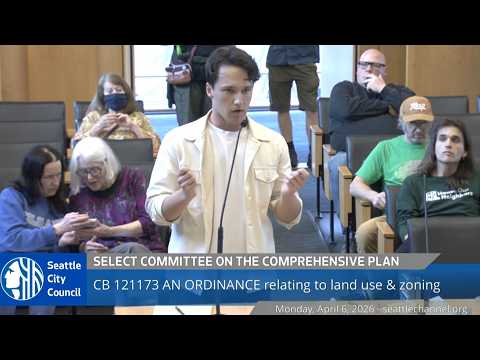
Seattle — Hundreds of residents, housing advocates and industry representatives told the City Council Select Committee on the Comprehensive Plan on April 6 that the next phase of the city's zoning update should allow more homes near frequent transit and include incentives for green construction.
"Without that zoning, those 18 families would not be homeowners in Seattle today," said Ryan Donahue, describing an Olympic Ridge project that produced 18 affordable homeownership units and arguing denser zoning lets the city build similar projects.
Why it matters: Councilmembers are weighing Phase Two of the One Seattle comprehensive-plan updates, focused on "Centers and Corridors," which would change where and how much housing can be built. Supporters say broader low-rise and mid-rise zoning near transit reduces vehicle miles traveled, helps the climate and creates more opportunities for families, teachers and service workers to stay in the city. Opponents warn about displacement, tree-loss and infrastructure strain if the changes proceed without targeted protections.
What supporters urged
Speakers representing neighborhood groups, nonprofit housing developers and business associations called for three changes they said would multiply housing and climate benefits: expand the walk-shed for frequent-transit upzoning beyond just main arterials; adopt a courtyard-block bonus to preserve green shared space; and add bonuses for passive-house and mass-timber construction to lower lifetime emissions and operating costs.
"We support this proposal and encourage you to strengthen it by adopting the Complete Communities Coalition amendment and adding an affordability tool so as we grow..." Ryan Donahue said, urging adoption of coalition amendments that would raise permitted density while attaching affordability incentives.
Industry and feasibility concerns
Representatives of developers and realtor groups backed increased capacity but urged the council to reassess mandatory housing-affordability (MHA) fee levels and called out rising project costs. One speaker noted that new utility requirements such as underground electrical infrastructure can add tens of thousands of dollars per building, potentially undermining small multifamily projects.
"If you do four units or EV chargers, $30,000 minimum — that can go to $1 million," a residential advocate said, warning the council to consider the effect of fees on smaller projects.
Equity and displacement questions
Several public commenters from historically affected neighborhoods asked the council to pair upzoning with strong anti-displacement measures such as affordable-housing overlays, community benefit agreements, and targeted subsidies for neighborhoods with high displacement risk. One longtime Southeast Seattle resident said changes that concentrate growth only on arterials risk worsening heat islands and ongoing displacement in Black communities.
What's next
The committee held the public hearing open through the evening to collect in-person testimony and recessed multiple times for additional sign-ups. No votes were taken during the hearing; the council will consider the testimony as it debates amendments and next steps.
Reporting note: Quotes and attributions in this article come from the Select Committee public hearing transcript on April 6, 2026.