Get Full Government Meeting Transcripts, Videos, & Alerts Forever!
Get email alerts on the Policing Data And Training topic
No spam. Unsubscribe anytime.
U‑M researcher shows how body‑camera footage can measure respectful policing, finds racial gaps
Summary
University of Michigan associate professor Nicholas Camp told Ann Arbor’s police oversight commission that body‑worn camera footage can be analyzed as data to reveal disparities in officers’ language and to measure the impact of training; commissioners questioned implementation limits and data interpretation.
Professor Nicholas Camp, an associate professor of organizational studies at the University of Michigan, told the Ann Arbor Independent Community Police Oversight Commission that body‑worn camera footage can be systematically used as data to study officer–community interactions and racial disparities.
Camp described a multi‑step research approach—matching footage to traffic‑stop records, transcribing interactions and sampling short clips for human ratings—that allowed his team to scale judgments across roughly 36,000 officer statements. "One of the most powerful tools that officers have at their disposal is their words," Camp said, arguing that small features of language and tone reliably shape how people perceive respect and institutional legitimacy.
Camp summarized experiments showing that raters consistently judged certain linguistic features as more respectful and that those respectful features appeared more often when officers spoke to white drivers in his Oakland study. He said department‑wide training that focused on procedural‑justice communication produced measurable increases in respectful language after training, though gaps between White and Black drivers persisted.
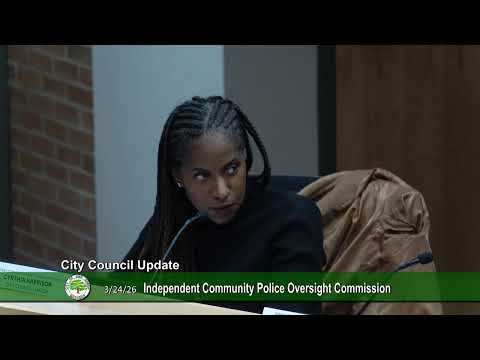
Commissioners pressed Camp on method and interpretation. Camp said current vendor tools (for example, transcription services provided by body‑camera vendors) streamline earlier manual work, but he cautioned that footage is a measurement tool rather than an automatic fix: "It can be a helpful tool for uncovering what happens in those conversations," he said, adding that whether cameras improve police–community relations "depends a lot on implementation."
On training implications, Camp identified two practical points the commission could consider: ensuring officers explain the reason for a stop and designing training that teaches discrete communication skills rather than relying on single‑session implicit‑bias workshops. "Just a brief statement—'I'm checking your license, this is why I'm talking to you'—makes a huge difference in the psychological experience of that interaction," he said.
Camp also warned about limits on drawing officer‑level conclusions from sparse stop samples: while department‑level trends were robust, he said, the small number of stops per individual officer means conclusions about specific officers should be drawn cautiously.
The commission’s discussion acknowledged the potential value of using body‑camera footage for training and oversight while noting privacy and procedural questions for implementation. The presentation was followed by an extended question‑and‑answer session with commissioners and members of the public.
The commission did not adopt new policy during the presentation; commissioners instead asked staff to consider how footage access and data systems (discussed later in the meeting) might support oversight and future research.