Get Full Government Meeting Transcripts, Videos, & Alerts Forever!
Get email alerts on the Parks Master Plan topic
No spam. Unsubscribe anytime.
Campbell commission approves parks master plan draft, forwards it to city council with amendments
Summary
The Parks and Recreation Commission approved the draft citywide Parks and Recreation Master Plan and voted to forward the document to the City Council with staff-drafted amendments addressing native planting language, pollinator gardens, and prioritization guidance; commissioners emphasized that project-level specifications and funding decisions will proceed through separate public review and budgeting processes.
The Parks and Recreation Commission voted to approve the draft Parks and Recreation Master Plan and forward it to the City Council with amendments the parks director will draft and attach to the final submission. The plan, described in the meeting as Campbell’s first comprehensive citywide parks and recreation master plan, outlines systemwide needs, chapter-by-chapter recommendations and an implementation schedule.
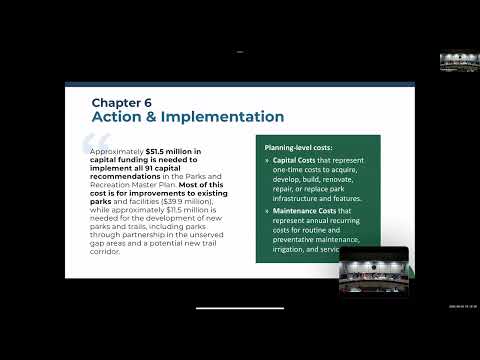
Commissioners and staff emphasized that the plan is advisory: staff noted it lays out priorities and a framework for future projects but is not a commitment of funds. The presenter said the draft includes six chapters and five appendices covering inventory, condition assessments, community priorities and an action plan; staff reported the capital improvement list totals projects estimated at about $51.5 million and advised that projects will be approved individually by the commission and City Council as funding becomes available.
Public engagement and edits: staff reported the plan was posted for three weeks and received 47 public comments focused on biodiversity and native habitat, funding needs and some terminology clarifications. In response, staff proposed edits including consistent language to favor native plantings where feasible, adding references to local open‑space grant programs, updating specific tables and replacing the word “burden” with “prevalence” in mapping materials. Staff also proposed adjusting graphics so maps and charts are clearer and adding interpretive signage language for native planting and pollinator features.
Site‑level concerns and process clarifications: commissioners raised site‑specific suggestions — for example, adding shade structures or drinking‑fountain types, keeping the rose plantings at certain parks, and circulation improvements (a pedestrian loop) at John D. Morgan Park. Staff repeatedly clarified that details such as equipment specifications, dog basins on drinking fountains, or turf conversion methods are project‑level decisions handled through later public processes and procurement, not through the master plan itself.
Program priorities: commissioners discussed unmet needs for adult programming (notably ages 30–50) and asked that the plan better reflect those service gaps. Staff said they will review language and consider whether to label some items as unmet needs rather than community values.
Vote and next steps: after discussion, a motion to approve the plan and forward it to the City Council with the parks director’s amendments was moved and seconded and passed with no opposition or abstentions recorded in the transcript. Staff said the amendments discussed at the meeting — including native‑planting language, adding references to grant programs, retaining certain rose plantings, promoting pollinator gardens and interpretive signage, and keeping site suggestions intentionally vague to preserve future public review — will be incorporated before the City Council submittal.
The commission’s action does not commit capital funds; staff reiterated that individual projects will require project‑level approval, public outreach and funding decisions by the commission and City Council.