Get Full Government Meeting Transcripts, Videos, & Alerts Forever!
Get email alerts on the Pedestrian Safety topic
No spam. Unsubscribe anytime.
Commission approves Occidental pedestrian traffic‑calming plan, acknowledges small parking losses under AB 413
Summary
The Burlingame commission voted unanimously to approve revised designs for pedestrian improvements at three Occidental Avenue intersections that add islands, high‑visibility crosswalks and some red curbing; staff estimated roughly five on‑street parking spaces would be lost in the neighborhood mainly because of state AB 413 rules.
The Burlingame commission voted unanimously to approve revised designs for pedestrian and traffic‑calming improvements along Occidental Avenue, advancing changes at three intersections — Chapen & Occidental, Ralston & Occidental and Occidental & Burlingame Avenue — that staff said will shorten crossing distances and improve visibility.
Mr. Wong, the project presenter, described the package as a fourth set of revisions tailored to community input and the city’s bicycle and pedestrian master plan. "The island acts as a refuge for folks," he said, and the revised designs include curb extensions, traffic islands to tighten intersection geometry, high‑visibility crosswalks and rubberized quick‑build elements that are removable if adjustments are needed.
The commission and residents discussed trade‑offs between pedestrian safety and on‑street parking. Mr. Wong said the team was able to restore a few spaces in revisions (he cited adding back three spaces at one location) but that some losses are unavoidable because Assembly Bill 413 requires red‑curbing on approach sides of intersections: "AB 413...talks about removal of parking spaces or red curbing up to 20 feet prior to the approach side of an intersection," he told the commission. On the revised drawings staff estimated about five parking spaces would be removed in the nearby neighborhood, with some locations reduced to 15 feet where bulb‑outs apply.
Residents urged the commission to watch for bottlenecks and visibility issues once the islands are installed. "I’m really happy to see a crosswalk that goes from the northeast side corner to the park," Tracy Sola said, while Bob Gilligan pressed staff to make sure approach sides had the required red curbing to preserve sight lines for drivers turning at Burlingame Avenue.
Commissioners said the design strikes the right balance. "I do believe the calming is needed," Commissioner Couchi said, citing frequent pedestrian use in the corridor; Commissioner Israel said the changes "will slow traffic down and make it much safer for pedestrians," and noted lighting upgrades could be considered later as a separate project.
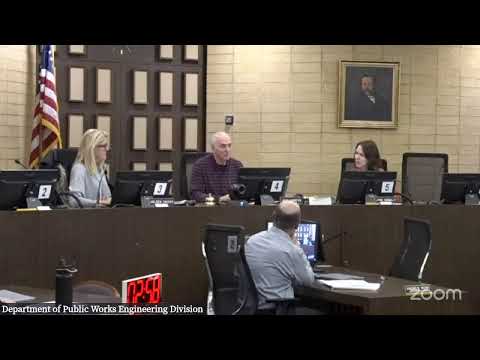
Commissioner Couchi moved to approve the Occidental pedestrian traffic‑calming improvements as presented; the motion was seconded and passed on a 3–0 roll call (Commissioner Couchi: yes; Commissioner Israel: yes; Vice Chair Martos: yes). Staff was directed to take the approved design to city council and to work with the design team to finalize plans for construction next year if funding and permitting proceed.
Practical details and next steps: the approved concept includes a landscaped island at the largest intersection, rubberized six‑inch raised elements in hatch‑striped areas where the community opposed only painted markings, and high‑visibility crosswalks. Lighting upgrades are not part of the current grant‑funded scope but were discussed as a future enhancement; staff said they will monitor performance and return to the commission if additional red curbing or adjustments are needed.
The vote advances the project to city council for any required approvals and to the design team to produce final construction drawings.