Get Full Government Meeting Transcripts, Videos, & Alerts Forever!
Get email alerts on the Land Use topic
No spam. Unsubscribe anytime.
Council affirms planning commission approval of Bond Hotel & Residences after heated public hearing
Summary
After hours of testimony from neighbors and Fountain Day School, the West Hollywood City Council denied an appeal and affirmed the planning commission's approval of the Bond Hotel & Residences at 7811 Santa Monica Boulevard; dissenting council members pressed safety and eligibility concerns over lot‑tie waivers under state density bonus law.
The West Hollywood City Council on April 7 denied an appeal and affirmed the Planning Commission's approval of the Bond Hotel & Residences, a mixed‑use project at 7811 Santa Monica Boulevard that proposes 126 residential units (including 20 set aside as affordable), 45 hotel rooms and subterranean parking. The council vote upheld the commission decision 3–2.
Senior planner Antonio Castillo told the council that the project spans three parcels and requests a 100 percent density bonus plus concessions and waivers under California's density bonus statutes; staff concluded those incentives are authorized by state law and that the planning commission's approval was supported by substantial evidence. "The application of state density bonus law is not a rezoning," Castillo said, adding that state law requires cities to allow specified deviations unless concrete, written public‑health or safety standards show a specific adverse impact.
Opponents led by appellant representatives Anita Gwami and resident Michael Carter argued the project is ineligible under the city's tied‑lot rules because the consolidated site is roughly 40,186 square feet and the municipal code sets a 50,000‑square‑foot threshold for mixed‑use lot ties. Gwami said waiving that threshold would "eviscerate the city's ordinance" and cited safety concerns tied to a single driveway on Orange Grove adjacent to Fountain Day School. "This is a single point of failure directly adjacent to 200 toddlers," an appellant representative said, urging a full environmental impact report and denial of the waiver.
The applicant team, represented by Jake Stevens and counsel Brian Wright Bushman, said the project meets state thresholds for density bonuses (mixed‑use projects with qualifying affordable units) and argued the project's eligibility and SQA (infill categorical) exemptions are lawful because the application was deemed complete in 2019 and the proposal satisfies statutory tests. "When a project qualifies, the city is limited in applying standards that would physically preclude construction at the proposed density," Bushman said.
Dozens of neighbors and business representatives testified. Fountain Day School leaders and parents urged the city to require binding construction‑period protections and immediate measures to avoid pickup‑drop‑off chaos after the applicant closed a privately leased lot near the school. "Our families had nowhere to safely unload," said Tori Hatch of Fountain Day School. Neighbors and longtime business owners—including representatives of Brick Fitness—warned about cumulative neighborhood impacts and asked the council to enforce local standards.
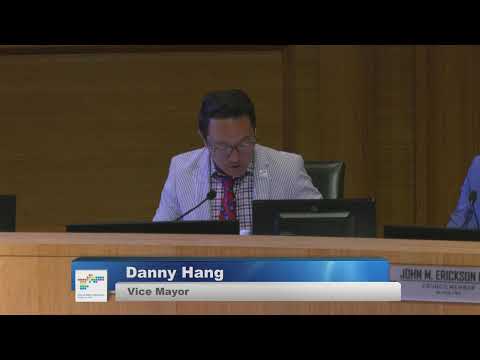
In deliberations Council Member Meister and Council Member Buyers said they would grant the appeal, citing the municipal eligibility threshold and public‑safety risks. Council Member Ericson, Vice Mayor Hang and Mayor Hman supported staff and the commission, citing the constraints of state housing law and the project's affordable housing components. The council approved the staff recommendation to deny the appeal and affirm the commission's approval (motion carried; final tally: deny appeal approved 3–2).
Next steps: staff will return the project to administrative permitting and final conditions consistent with the Planning Commission resolution. Council directed staff and the applicant to work on additional mitigation related to circulation and construction‑period protections for Fountain Day School; staff said they would coordinate with the school, code enforcement and the applicant on specific protective measures and a circulation study.
Why it matters: The decision underscores the tension between local zoning rules and California's density bonus statutes, and highlights how safety concerns around schools and neighborhood circulation can figure prominently in public comment and council deliberations. The project will proceed subject to the conditions of approval set by the planning commission and the council.
Quote: "State law requires granting deviations unless specific adverse impacts can be identified," staff said. Opponents countered, "You cannot wave a 10,000‑square‑foot deficit."
What happens next: The applicant will proceed with final entitlements, and staff will report back on circulation and school‑safety mitigation measures the council directed be pursued.