Get Full Government Meeting Transcripts, Videos, & Alerts Forever!
Get email alerts on the Immigration Enforcement topic
No spam. Unsubscribe anytime.
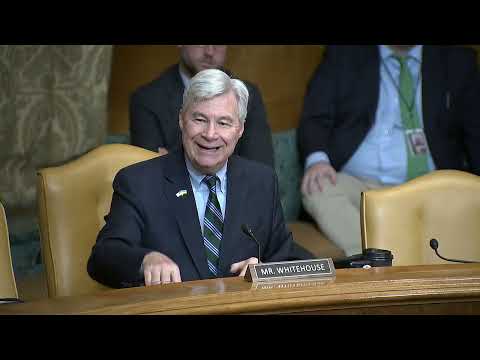
Sen. Whitehouse cites court rulings and criticizes ICE courthouse tactics
Summary
Sen. Whitehouse told a Senate hearing that federal courts in Rhode Island require warrants for ICE detainers and described alleged incidents in which masked ICE agents violated courthouse rules, threatened a judge and briefly detained the wrong person, saying such conduct helps explain why local police sometimes decline to cooperate with ICE.
Sen. Whitehouse told colleagues that federal courts in Rhode Island have made clear local and state officers can be held liable for holding people under ICE detainers without a proper warrant, and he urged the Senate to consider the practical consequences of ICE's tactics.
The senator said that "sanctuary city" is a political term and emphasized the need for precision before describing what he called binding law in his state: a district-court decision in Rhode Island that, he said, has been upheld by the United States Court of Appeals for the First Circuit and requires a warrant for certain detentions tied to ICE. Whitehouse said that, from a federal point of view in Rhode Island, "state and local officials who hold somebody under a detainer where ICE doesn't have a warrant, can be held liable."
He then turned to the conduct of ICE agents in state courthouses. Whitehouse said masked agents appeared in the Rhode Island Superior Court "in violation of an agreement that they have with the court" and operated "with cameras in violation of a courthouse rule that forbids taking photographs." He described an episode in which agents pursuing a 30‑plus‑year‑old allegedly mixed up that person with a high‑school intern who had been returning to a judge's car. According to Whitehouse, agents told the judge, "we are going to smash your effing windows and we are going to drag you out of your effing car if you don't turn over this..." and then took the intern to a car for "half an hour" before realizing the mistake.
"Why would regular law enforcement...want to cooperate with an organization whose law enforcement behavior is so widely irresponsible and unprofessional?" Whitehouse asked, characterizing the conduct as difficult to justify.
He explained the routine law-enforcement practice of "deconfliction," saying it is elementary training for officers so that local agencies know "what is going on" during operations and can avoid dangerous overlap. Whitehouse said he asked Secretary Noem about the problem and that the secretary reportedly did not know the difference between deconfliction and cooperation. "And yet ICE refuses to deconflict," he said, adding that this gap represents "a massive hole in the way in which DHS thinks about this stuff."
Whitehouse concluded that, in that environment, many local police chiefs are making "sensible decisions" about whether to cooperate with ICE. He framed his remarks as an explanation for why some local authorities choose limited or no operational cooperation with the agency.
The remarks in the hearing recounted court decisions and alleged incidents; Whitehouse did not put forward a specific bill or motion during this segment, nor did the transcript record a vote on the matter.