Get Full Government Meeting Transcripts, Videos, & Alerts Forever!
Get email alerts on the Public Art Display topic
No spam. Unsubscribe anytime.
Milton weighs donated TH‑57 helicopter against 50‑year T‑28 display as community debates cost and history
Summary
City staff reported acceptance of a donated TH‑57 helicopter and reviewed a 50‑year outdoor T‑28 display that the Naval Aviation Museum still owns; residents urged preserving the T‑28 while others supported replacing it or keeping both, and council discussed funding, pedestal costs and potential museum decisions.
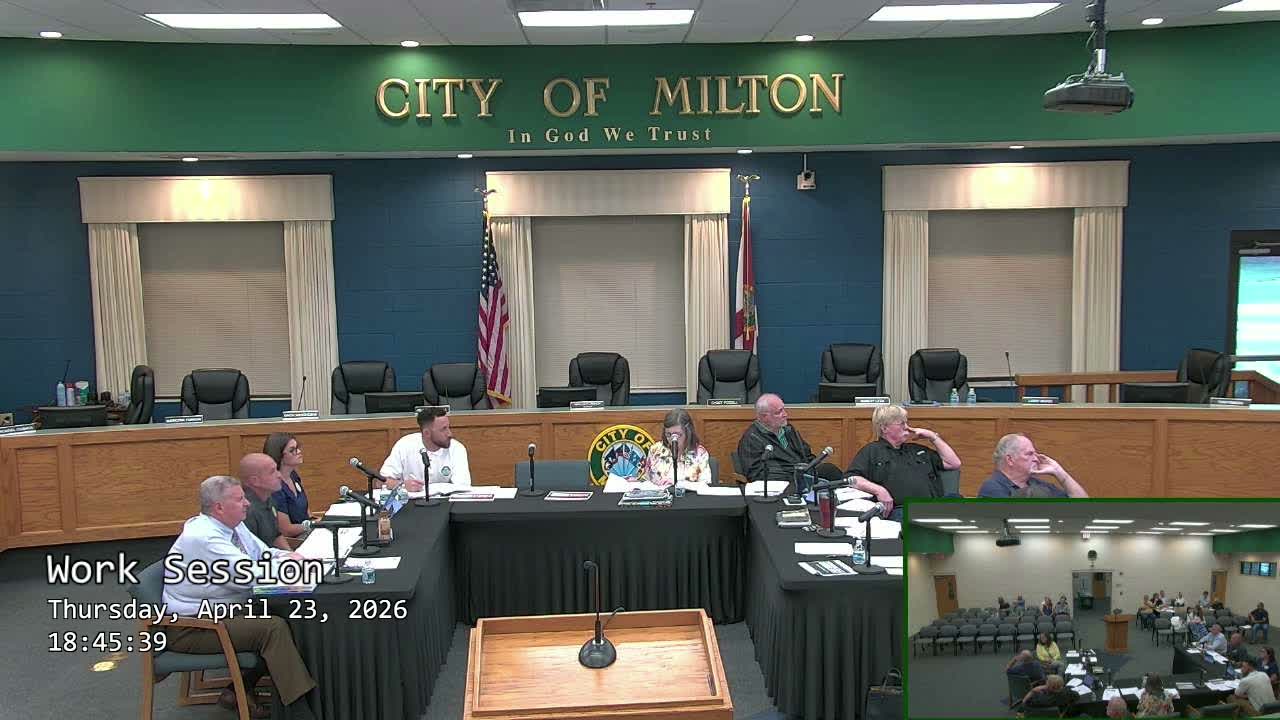
City staff told the Milton City Council on April 23 that the National Naval Aviation Museum has completed steps to transfer a TH‑57C Sea Ranger helicopter to Milton and that Leonardo has offered to prepare initial paint and display prep. The council had earlier accepted the helicopter in March; the museum retains authority over final transfer and the fate of the existing T‑28 Trojan aircraft, which is on long‑term loan and was last inspected in 2018 (condition rated ‘poor’).
Staff said routine maintenance for the T‑28 runs about $4,000–$5,000 a year; full restoration to museum display standards could cost in the $250,000–$500,000 range depending on condition. Preliminary engineering estimates for a new pedestal and site work at the Riverwalk run roughly $80,000; retrofitting the existing airplane pedestal at Milton High School would cost substantially less. The city does not currently have funds budgeted for a full restoration.
A city survey restricted to Milton residents (staff emphasized results were city‑resident only) reported 11 responses favoring keeping the T‑28 in place, 28 favoring replacing the T‑28 with the helicopter, and 20 favoring keeping both displays.
Council and public comment split along pragmatic and sentimental lines. Several residents and council members framed the T‑28 as a 50‑year local landmark that residents want to preserve; others said accepting the helicopter (or keeping both) is desirable if funding can be identified without tapping reserves. Several speakers suggested private fundraising, volunteer restoration partnerships with local technical schools, or grant opportunities and recommended staff explore those options. Staff said that if Foley (another city that inspected the airplane) declares interest and moves forward, that could affect availability and the museum’s decision; the museum ultimately decides transfers.
Why it matters: The discussion affects local cultural heritage, municipal maintenance obligations and reserves, and the city’s public display policy. Options include keeping the T‑28 in place and seeking private funding for restoration, replacing the T‑28 with the donated helicopter, or attempting to display both (which would require private funding or identified new revenue).
Next steps: Council asked staff to continue outreach and research funding options, wait for the Naval Aviation Museum and Foley to finalize their assessments, and return with cost estimates and possible fundraising strategies before committing city funds.