Get Full Government Meeting Transcripts, Videos, & Alerts Forever!
Get email alerts on the Wastewater topic
No spam. Unsubscribe anytime.
Residents urge Milton council to pause wastewater design over river‑protection concerns
Summary
Invited speaker Dave Samples told Milton’s council the city’s April 1 preliminary design report (PDR) for the wastewater treatment project appears to remove vegetation and replace it with sod, raising erosion and water‑quality risks for the Blackwater River; council scheduled a May 23 workshop to review engineering and permitting.
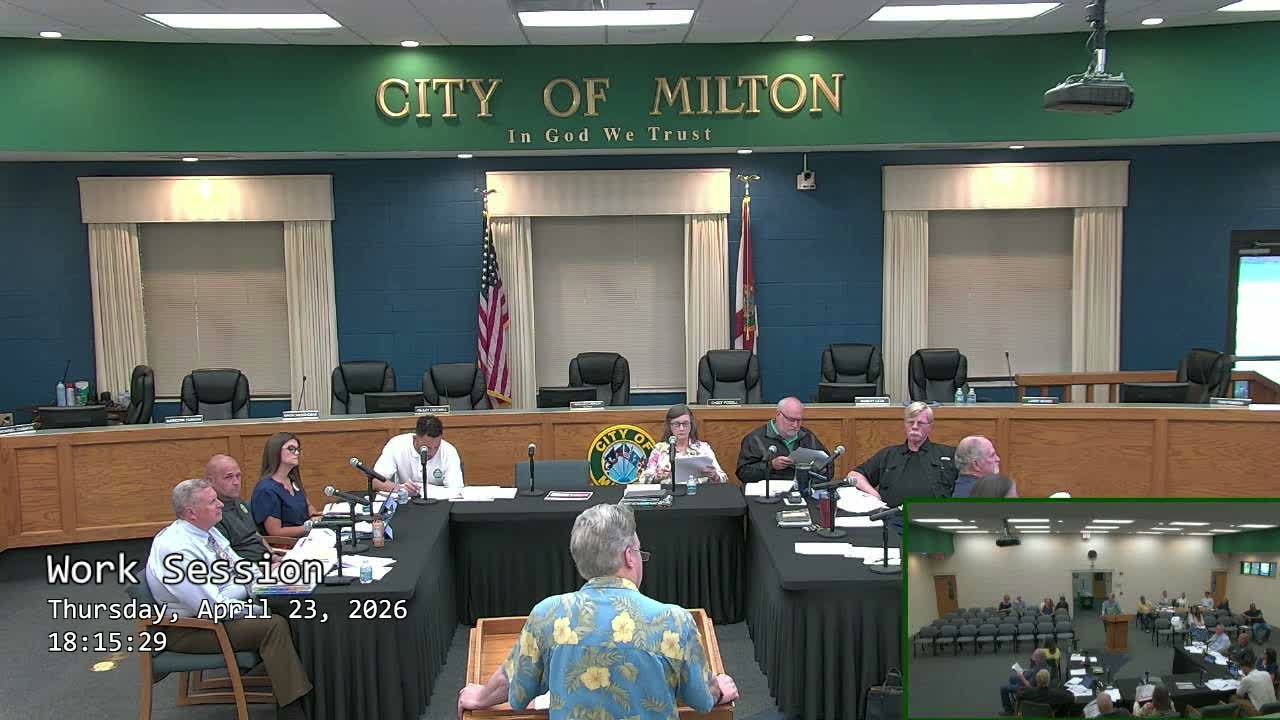
Dave Samples, an invited speaker representing concerned residents around the Blackwater River, told the Milton City Council at its April 23 work session that the city’s April 1 preliminary design report (PDR) for a planned wastewater facility raises environmental risks and engineering questions. "Our biggest thing has always been asking the basic question, are we going to do harm?" Samples said.
Samples said the PDR’s language and drawings indicate plans to clear vegetation and install sod across parts of the newly purchased Estes property. He warned that geotechnical borings were concentrated in the level, eastern portion of the site and not on sloped areas, meaning spray‑field designs may have been extrapolated beyond sampled soils. "They sampled within the upper area, but then they interpolated or did whatever and said, 'Well, we're going to spray all over the entire thing,'" Samples said, arguing that spray fields on steep, sandy slopes increase erosion and runoff risks that could harm the Outstanding Florida Water (OFW) designation for the Blackwater River.
Samples described case studies of nearby slope failures and erosion and urged a defense‑in‑depth approach: keep the river and wetlands protected by undisturbed buffer acreage upslope. He recommended keeping roughly 100 acres of the Estes property as a buffer and clearing a smaller, less risky footprint instead. "We believe the PDR proposal has Milton walking into a costly trap," he said, urging the council to preserve buffer acreage and to scrutinize infiltration and slope data before approving permitting steps.
Mayor (S1) and staff acknowledged the concerns and said staff and the city engineer (and outside consultants) will review the PDR and the geotechnical record. City staff told council members they will present a complete design, permitting, and financing update at a May 23 special called meeting; staff also said that council will be asked then to consider a formal reserve commitment to advance the project. Several council members said they wanted time to review the materials and to prepare technical questions for the engineer and permitting team before taking any policy action.
Why it matters: the Blackwater River is an OFW and is subject to enhanced environmental protections. Samples said the combination of steep, sandy slopes and high local rainfall make erosion and sod‑based spray fields a poor match for parts of the site unless the design reflects slope‑specific soils data and robust mitigation.
Next steps: Council directed staff to collect follow‑up information, consult the engineer, and return to the council with detailed permitting, geotechnical, and financing materials at a May 23 workshop; no formal vote or funding commitment was taken on April 23.