Get Full Government Meeting Transcripts, Videos, & Alerts Forever!
Get email alerts on the Traffic Calming topic
No spam. Unsubscribe anytime.
NDOT presents final Dobs Avenue speed-cushion plan; residents ask to shift placement near parking lot
Summary
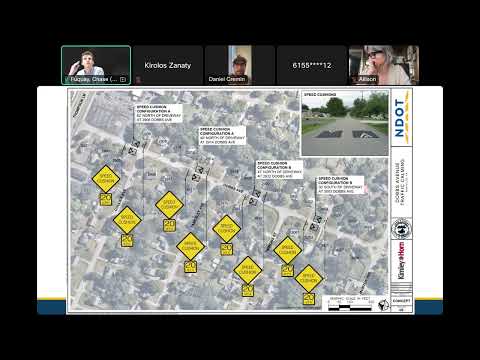
The Nashville Department of Transportation presented final design plans for four speed cushions on Dobs Avenue and told residents ballots will be mailed; neighbors asked NDOT to move the northernmost cushion closer to Thompson Lane but south of two parking-lot access points to better address cut-through traffic.
The Nashville Department of Transportation (NDOT) on a neighborhood call presented final design plans for speed cushions on Dobs Avenue and said ballots will be mailed to eligible properties; the project moves forward if two-thirds of respondents vote yes.
NDOT contractor Chase Pay led the presentation, saying the neighborhood-calming program focuses on residential streets and engineering solutions to reduce speeds. "We focus heavily on speed reduction," he said, and cited program data showing cushions reduced average speeds from about 31 to 22 mph and 85th-percentile speeds from about 37 to 25 mph in similar projects.
The plans show four roughly evenly spaced speed-cushion locations between Thompson Lane and Morton Avenue, with approximate references near 2905'2906 Dobs Avenue, 2913'2914, near 2922, and between 3003'3004. Pay said the design includes two-cushion cross-section configurations (A and D) and that the choice reflects pavement width: narrower streets (about 22 feet and under) receive two cushions; wider streets may warrant three.
Residents raised placement concerns tied to a large parking lot that sits near the northern end of the project. Daniel, who said he lives at 2905 Dobs Avenue, asked whether the cushion closest to Thompson Lane could be moved farther north toward Thompson to slow vehicles cutting through the parking lot and adjacent streets. "I live at 2905 Dobs Avenue," he said, describing heavy pedestrian and vehicle use near the lot.
Anna Hatch, calling in, asked whether a cushion can be placed in front of parking-lot access points; Pay replied there is a driveway offset requirement and that cushions cannot be placed directly in front of access points. "I think we have to be a minimum of 15 feet off of it," he said, adding NDOT would likely place cushions between two access points rather than directly blocking an entry.
Pay said staff will review the suggestion and try to move the northernmost cushion "as far to the north as we can get, keeping it on the south side of the two church driveways." He also cautioned that moving the cushion farther north could leave a bypass route that preserves some cut-through traffic, and asked designers to consider the parking-lot access pattern before finalizing placement.
On design constraints, Pay noted there are guidelines for setback from stop-controlled intersections (he estimated roughly 100'150 feet when speaking off the top of his head) and that driveway and intersection spacing affect exact cushion locations. He confirmed that striping is not part of this project.
Pay reviewed the project timeline and neighborhood balloting: NDOT will finalize plans, post them on the traffic-calming website and mail ballots with unique IDs. "I would say the ballot should be sent out within the next week to week and a half," he said. Voting will be online via a unique ID and QR code for a six-week window; the project requires a two-thirds (approximately 66%) majority of respondents to pass. Pay clarified the outcome is based on those who respond, not the total number of ballots mailed.
Eligible voters are residential properties, churches and schools directly on or cornering Dobs Avenue (one vote each); vacant parcels and businesses are ineligible. Pay also said Council Member Jenny Welch is included in project correspondence and kept informed, but the neighborhood vote drives whether the project proceeds.
Several residents asked about outreach and delivery of ballots. One participant said they rely on a PO box because a curb mailbox has been repeatedly hit; Pay asked that the resident provide the PO box to staff so the unique ballot ID can be delivered and followed up by email.
Pay said he could not provide a firm construction schedule at the meeting and would follow up about installation timing after the ballot phase. The meeting closed with NDOT inviting written feedback and promising to incorporate feasible adjustments before ballots are sent.
Next steps: NDOT will post the final plans online, mail ballots with unique IDs to eligible properties, accept votes for six weeks and report the outcome; if two-thirds of respondents vote yes, the Dobs Avenue speed-cushion project will be scheduled for construction.