Get Full Government Meeting Transcripts, Videos, & Alerts Forever!
Get email alerts on the Traffic Calming topic
No spam. Unsubscribe anytime.
NDOT proposes speed cushions, radar signs and painted bulb‑outs for Bay Cove Trail; residents press for adjustments near Blythe Court
Summary
NDOT staff presented a revised traffic‑calming plan for Bay Cove Trail that would install four sets of speed cushions, radar feedback signs and painted bulb‑outs. The project will go to an online ballot (66% of votes cast required); residents asked NDOT to reassess cushion placement near Blythe Court and hill approaches.
Amy Burge, a traffic engineer and consultant with the Nashville Department of Transportation (NDOT), presented a revised traffic‑calming plan for Bay Cove Trail during a virtual neighborhood meeting on May 12, 2026. The plan calls for four sets of speed cushions, radar feedback signs in both directions, a painted bulb‑out at the Rolling River Parkway intersection and roadway striping to narrow travel lanes where sidewalks are absent.
Burge said NDOT selected Bay Cove Trail through its application‑based traffic calming program and cited the street’s measured data: an 85th percentile speed of about 35 mph where the posted limit is 25 mph and roughly 1,200 vehicles per day at a midpoint count. ‘‘At a vehicle speed of 25 mph, if a pedestrian is hit, that pedestrian has an 89% chance of survival,’’ Burge said, summarizing national safety data the program uses to justify measures.
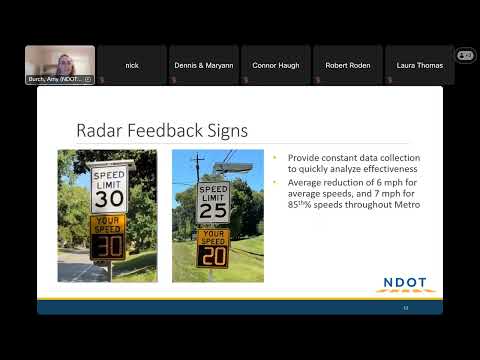
NDOT staff described the treatments included in the design: speed cushions (rubber modular devices that allow emergency vehicles to straddle gaps), radar feedback signs that show driver speed, painted 'slow safer shoulder' striping to visually narrow lanes, and painted bulb‑outs to tighten turning radii. Staff also showed before‑and‑after comparisons from six streets where average speeds fell from about 31 mph to 22 mph and 85th‑percentile speeds fell from 37 mph to 25 mph after vertical measures were installed, and said those results support using cushions on straight sections of Bay Cove Trail.
The map and plan presented to residents indicate four cushion locations spaced along the road, signage and flexible white delineator posts adjacent to cushion sites, and radar feedback signs placed where cushions cannot be used because of hills or curves. Specific plan callouts mentioned approximate parcel addresses near the cushions (for example, locations near 7013, 7033, 7113/7117 and 7181) and a painted bulb‑out at Rolling River Parkway to reduce high‑speed turning movements.
Residents raised placement and spacing concerns during a question‑and‑answer period. A neighbor who identified their house by address and location on the street said cushions near a stop sign and on steep grades may not slow drivers at the critical points. NDOT responded that cushions have grade and driveway constraints and that staff would re‑check grades and driveway locations near Blythe Court to see whether a cushion could be shifted closer to the top of the hill.
One attendee asked why a traffic circle could not be used at Rolling River Parkway. Burge said NDOT measured intersection geometry and visibility and concluded a roundabout would not fit safely into the intersection because of vehicle turning paths and sight‑distance concerns.
Several residents urged a radar feedback sign and cushions on the west end approach from Rolling River Parkway to catch drivers 'as they come around the curve' and before they accelerate up the Blythe Court hill. Burge said physical cushions generally force drivers to slow more reliably than radar signs, and staff typically avoid colocating cushions and radar displays immediately adjacent to one another because cushions induce the necessary deceleration.
NDOT clarified how the following public step will work: after final adjustments to cushion spacing (if any), residents who abut Bay Cove Trail will receive a postcard with a unique ID and a link to an online ballot. The ballot is open six weeks; if 66% of votes cast are 'yes,' NDOT will proceed with construction. Staff said condos previously included in an earlier draft were excluded after program review and that 65 eligible properties will receive ballots. Burge noted the project is already funded; the ballot determines whether vertical measures (speed cushions) are installed as planned. If voters reject the ballot, NDOT said it would still consider installing non‑vertical measures shown in the plan (signs and pavement markings) without holding another ballot.
NDOT staff committed to posting final design plans on the department’s engagement hub and to mailing ballots within about one to two weeks after checking cushion placements near Blythe Court. Residents were given staff contact information and directed to NDOT’s traffic calming hub for project status updates and the eventual ballot results.