Get Full Government Meeting Transcripts, Videos, & Alerts Forever!
Get email alerts on the Zoning Density topic
No spam. Unsubscribe anytime.
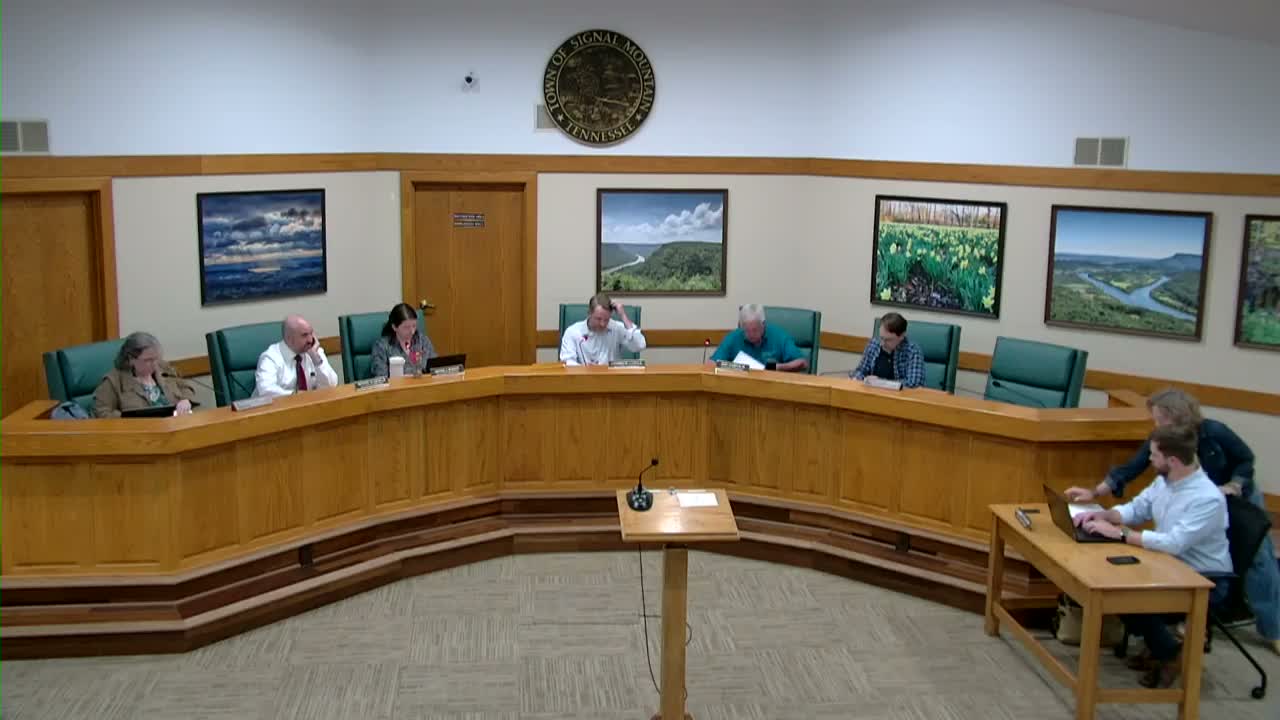
Signal Mountain planning commission votes to recommend cutting residential density in LDR and RE zones
Summary
The planning commission voted to recommend a zoning ordinance amendment that would reduce residential density in Low Density Residential and Residential Estate zones—moving many potential future lots toward a roughly 1 dwelling unit per 5-acre standard—after hearing public comment from a nearby property owner who said the change would sharply limit development of a 36-acre parcel.
The Signal Mountain Planning Commission voted to recommend a zoning ordinance amendment that would reduce the density factor in the town’s LDR (Low Density Residential) and RE (Residential Estate) zones, a change the presenter said would prioritize infill lots and increase property-tax revenue to address infrastructure needs.
The presenter, who requested the item be placed on the agenda, told commissioners the change would shift some current density ratings ‘‘from 1 dwelling unit per acre or 1 dwelling unit per half acre to 1 dwelling unit per 5 acre,’’ and said the intent is to focus growth on already-platted infill lots so the town can fund road and service improvements without immediately increasing service costs.
The change would not affect existing approved or vested preliminary plats, the presenter said, and would not alter rules for minor subdivisions. Commissioners asked several clarifying questions about how the zoning change differs from subdivision regulations; the presenter and members agreed the zoning amendment is separate from but related to the town’s subdivision rules and that subdivision regulations should be reviewed alongside any zoning change.
During public comment, a local property owner described owning 36 acres and explained how the proposed 0.2 density factor (1 unit per 5 acres) would reduce the number of potential lots on the parcel from the tens-of-lots range under current conventional or conservation formulas to roughly six lots. The property owner said the 0.2 factor ‘‘seems pretty…extreme’’ and asked whether the commission could agree on a more moderate standard.
Commissioners acknowledged that the proposed five-acre metric is large and likely to be debated. A commissioner suggested alternative minimums—two, three or four acres—could be explored; another asked whether shared septic systems or other subdivision-level tools might address environmental concerns while allowing more lots. The presenter said the five-acre calculation was informed by historical data on septic failures on Signal Mountain and framed the amendment as a near-term way to increase infill building and revenue while subdivision rules are updated.
On procedure, the commission briefly made and then withdrew an initial motion to recommend approval after members realized discussion had not been completed; the motion was reintroduced, seconded and carried. Commissioners noted the change requires two readings to amend the zoning code and that the planning commission and council can revisit the substance as subdivision regulations are updated.
The commission’s recommendation will go to the town council for consideration under the usual ordinance-reading process; commissioners directed staff to place subdivision-regulation review on a future planning commission agenda.
The meeting transcript does not record a roll-call vote listing each member’s name for the motion to recommend; members expressed verbal ‘‘aye’’ or ‘‘no’’ responses on the record during the final vote.
The planning commission adjourned after handling the item.