Get Full Government Meeting Transcripts, Videos, & Alerts Forever!
Get email alerts on the Land Use topic
No spam. Unsubscribe anytime.
Signal Mountain planning commission conditionally approves Shackleford Ridge preliminary plat after geotechnical review
Summary
After a geotechnical presentation and staff recommendation, the Signal Mountain Planning Commission voted to conditionally approve the Shackleford Ridge preliminary plat, attaching two conditions: further study of a second access consistent with the International Fire Code, and a peer review and correction of the engineering report.
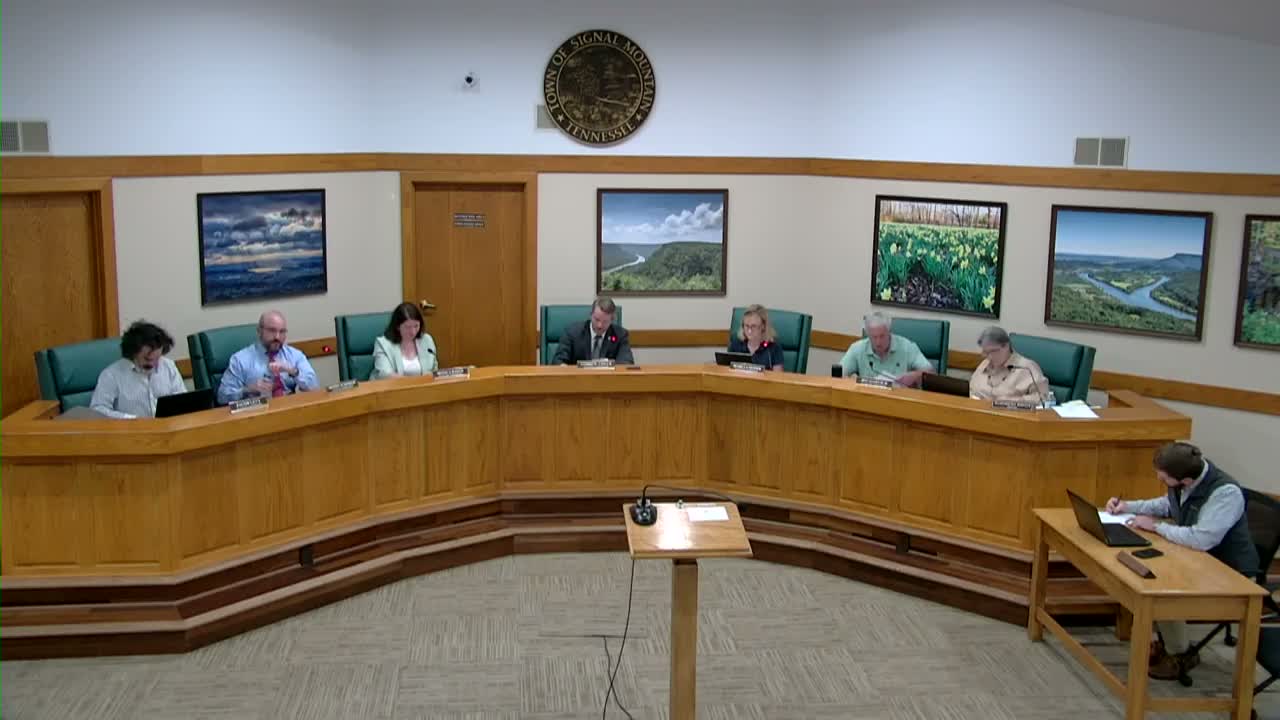
The Signal Mountain Planning Commission on March 5 conditionally approved the preliminary plat for the Shackleford Ridge subdivision after hearing a geotechnical presentation from the developer's consultant and a staff recommendation to approve the plat.
The commission's approval was made subject to two conditions proposed by the mayor and adopted by the board: that the developer continue to investigate a second access in line with the International Fire Code, and that the recently submitted engineering report be peer reviewed and corrected for identified errors. The motion passed with one commissioner recorded in opposition.
Town planning staff provided the commission with a brief history of the application, noting the project was first submitted as a concept late last year and has returned to the commission several times for review. Staff representative Garrett said his review of the preliminary plat found it met the town's subdivision regulations and zoning ordinance and recommended approval of the plat, while reserving construction-plan level enforcement and detail review for the next phase.
The hearing centered on a geotechnical report the commission had required. Derek Kilday, an engineer with UES, summarized the firm's work and the relevant historic mapping: "If you're looking at this property ... on this map you'll see some circles with smaller dots in them. Those are abandoned mines as of 1963," he said, adding that mapped coal does not necessarily mean it was mined at a particular location. Kilday said the team supplemented document review and geophysics with soil borings and did not encounter large voids in their borings: "we did not hit voids in the borings," he said, and reported approximately "45 feet of competent rock below where these houses are going to bear" in the tested locations.
Commissioners pressed the consultant on technical points. One member asked whether any existing houses sit over the anomalies shown on historic maps; Kilday replied the borings were targeted to potential anomalies and had not revealed significant voids. Commissioners also asked why some geophysical arrays showed higher RMS error; Kilday said sandy soils and field saturation can affect those numbers and that borings provide the most reliable confirmation.
The formal motion to approve included two conditions. The first asked the developer to continue to investigate a second subdivision entrance "in line with the International Fire Code." Commissioners debated whether a second access was a mandatory requirement under local ordinance or merely an advisable safety measure; staff and another commissioner noted local ordinance thresholds will typically require a second entrance only above a higher unit count (one commissioner referenced a 200-home threshold in the applicable appendices), while the town's fire chief had indicated concern in his comments. The second condition required that the engineering report be peer reviewed and that any errors be corrected before further processing.
Several commissioners and members of the public had raised broader concerns about traffic, school overcrowding, tree canopy and the town's character. One commissioner framed those concerns as grounds the commission might use to deny a plat only if supported by material evidence from appropriate experts: "If the school board had written a letter to us that said adding this subdivision would be detrimental to the educational value of the schools ... that's not arbitrary," the commissioner said, arguing the commission needs outside expert opinions to support denial based on such impacts. Another commissioner urged caution about denying an application without a defensible legal basis, saying a denial could invite costly litigation against the town.
After debate, the commission clarified that the preliminary-plat approval does not eliminate subsequent, more detailed construction-plan review by staff and regulator checks (including TDEC and county wastewater requirements as noted in the meeting). The chair asked for the vote; with seven members present the motion for conditional approval passed with one recorded no vote.
The commission adjourned after taking no additional new business. The conditions attached to the approval will be tracked during the next phases of plan review and construction permitting.