Get Full Government Meeting Transcripts, Videos, & Alerts Forever!
Get email alerts on the Land Use Zoning topic
No spam. Unsubscribe anytime.
Signal Mountain council adopts temporary lower-density rule for ridge-top subdivisions
Summary
The Signal Mountain Town Council on April 20 adopted Ordinance 2026-15, which lowers allowable subdivision density in constrained ridge-top areas as a temporary measure while the town updates its land-use plan and subdivision regulations; proponents cited sewer, road and school capacity concerns, opponents said process and economic impact need more study.
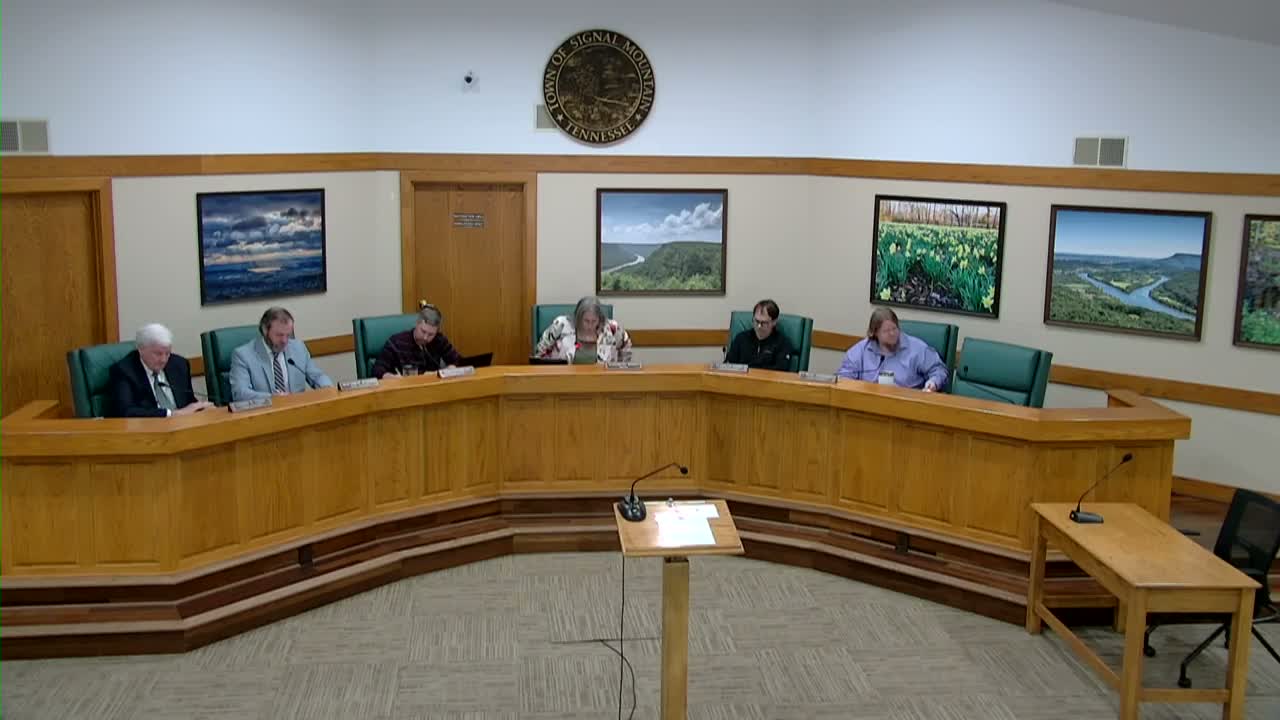
Signal Mountain — The Signal Mountain Town Council voted April 20 to adopt an amendment to the town zoning ordinance (recorded as Ordinance 2026-15) that reduces allowable subdivision density in geographically constrained ridge-top areas and applies prospectively while the town updates its land-use plan and subdivision regulations.
Mayor Elizabeth Baker, who said she brought the ordinance forward, told residents the measure is intended to “promote and prioritize infill lot building” and to be temporary while the town completes planning updates. “I am the one that brought this forward,” Baker said, adding the council hopes the change will last roughly a year, and no longer than 18 months, while work on the land-use plan and subdivision regulations proceeds.
Supporters framed the change as a tool to limit cumulative impacts on roads, stormwater systems, emergency response and school capacity. Vice Mayor Clay Krumbliss cited a longstanding sewer moratorium and planning studies as part of the rationale, saying Signal Mountain faces distinct infrastructure constraints as a ridgetop community. “Signal Mountain deserves protection and will provide it,” Krumbliss said, arguing the ordinance is consistent with the town’s 2018 land-use plan and recognized planning standards for communities with environmental and access limitations.
A council member who spoke at length described the ordinance as a generally applicable change to the density-calculation framework rather than a parcel-specific rule, and emphasized that residential use remains allowed under the amended framework. The same council member cited a planning-level fiscal impact analysis prepared for the Shackleford Ridge project, which the staff report recorded as assuming 106 homes and estimated roughly $296,000 annually in town property tax revenue and about $5,500 in stormwater fee revenue; the council member said those planning-level estimates show growth is not free and that the town must weigh long-term service costs as well as new revenue.
Opponents and some landowners told the council the proposed five-acre minimum for some subdivision types is excessive and could strip economic value from property. Tom Baird, a property owner on Shackleford Ridge, urged the council to slow the process and present studies and analysis before changing zoning rules. “I haven’t seen a single study,” Baird said. Pat St. Charles, another resident, called a five-acre minimum a “five- to tenfold increase” over prior lot-size provisions and urged a smaller-scale approach.
Council supporters repeatedly framed the decision as prospective regulation and said it should withstand judicial review so long as it bears a rational connection to public health, safety and welfare. Krumbliss and another council member referenced the Tennessee Code Annotated (TCA), a Tennessee Municipal Technical Advisory Service (MTAS) study, and the town’s federal stormwater obligations (Phase 2 NPDES under the Clean Water Act) when discussing legal and technical constraints. The council member also noted that Signal Mountain’s geology contributes to septic failures and that the town’s portion of a regional wastewater system has contributed disproportionately to reported sewer overflows in recent reporting years; those figures were cited on the record by the council member as part of the justification.
A motion to approve the ordinance was made and seconded; the mayor called for those in favor and those opposed and the council approved the amendment (the transcript records vocal “Aye” responses but does not include a roll-call tally in the record). The ordinance as presented amends specified subsections of the town zoning code and applies a revised gross density factor to covered major residential subdivisions; the council recorded the adoption as a forward-looking land-use intensity regulation rather than an acquisition, easement or physical taking.
Council members said the town’s planning commission will undertake a comprehensive review of subdivision regulations and the land-use plan that will examine infill inventory, infrastructure availability, conservation subdivision incentives and density options. Supporters said the ordinance is intended to be temporary and that the council can revisit density if infrastructure capacity is demonstrated.
The meeting concluded with brief board reports and an announcement of a community fundraiser for an inclusive playground at Althouse Park, after which the council suspended the remainder of the agenda and adjourned.
What’s next: The town’s planning commission will proceed with the promised comprehensive review of subdivision regulations and the land-use plan; the council indicated the density amendment is intended to be time-limited (roughly 12–18 months) while that work proceeds. The transcript does not record a specific effective date or a detailed enforcement schedule in this session.