Get Full Government Meeting Transcripts, Videos, & Alerts Forever!
Get email alerts on the Community Responder Eligibility topic
No spam. Unsubscribe anytime.
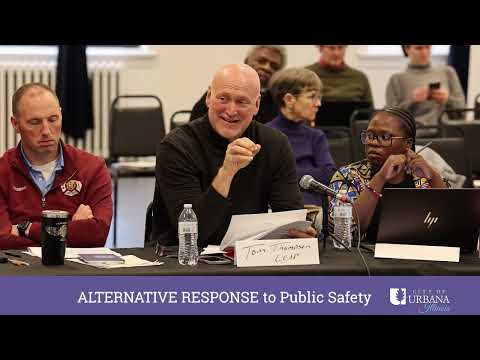
Urbana task force debates when to send community responders and when police are needed
Summary
Urbana’s Alternative Response Task Force reviewed 97 sample call narratives and wrestled with calls that split opinion—particularly ‘remove subject,’ certain crisis-intervention and disorderly-subject scenarios—concluding that better dispatch screening and clear escalation protocols could allow many calls to be handled by community responders while incidents that indicate violence or evidence of a crime should prompt police or co-response.
Urbana’s Alternative Response Task Force spent its fourth meeting reviewing 97 scenario narratives to decide which 911 calls could be routed to unarmed community responders instead of police. Facilitator D opened the session by saying the group would focus on calls with less than 75% agreement and that the scenario reviews help shape recommendations for Urbana.
Amos, presenting the coding results, said the panel’s sample showed “there was 75 to 100% of you agreed that … eligible for community responders” for many call types, but that certain categories—crisis intervention and disorderly-subject calls—had far less consensus. The pie-chart breakdown showed the largest share of community-responder–eligible calls involved conflict resolution or service-connection tasks, while mental-health and substance-use calls were smaller shares.
Task-force discussion centered on three clusters of ambiguous calls. For “remove subject” calls—examples included a person refusing to leave near Northstar Cafe or a caller asking that an intoxicated houseguest be removed—members said robust screening questions (weapons, history of violence, frequency of incidents and whether the caller or subject is the first-party) could turn many “maybe” answers into consensus for a community-responder visit. Tom framed the conversation by urging clearer narratives and screening so the right responder type is chosen, telling the group there was “no judgment right or wrong” for initial answers.
On narratives that flagged possible sexual assault, a bomb claim or a caller too vague to distinguish needs, advocates urged survivor-centered screening to determine if the caller wanted police involvement or only transport and medical care. A representative identified in the meeting as RACES warned that “sending police to someone who might have no interest in being involved in an investigation could actually do further harm to them.” Law-enforcement voices, however, cautioned that calls describing a rape or clear evidence of a crime sometimes require police resources; a UPD representative said he did not expect any of the three high-risk examples to automatically require police every time, but added “we need more information” before ruling out an armed response.
On disorderly-subject vignettes (vandalism, grease poured on a car, disputes with a tow-truck driver), members sketched a middle path: send community responders for mediation and conflict resolution when screening shows no ongoing violence or weapons, with a built-in escalation pathway so police can be summoned if the subject requests to press charges or the scene shows criminal evidence.
The panel agreed on next steps: staff will refine dispatch-screening recommendations, examine caller-notification models (clinician in dispatch, CRT-on-phone with 911, or referral models), and draft protocols that make clear when a community responder may escalate to police. D closed by noting the group’s tentative lean toward community responders for many low-immediate-risk calls while retaining police or co-response for incidents that show indicators of violence or criminal evidence.