Get Full Government Meeting Transcripts, Videos, & Alerts Forever!
Get email alerts on the Parks Master Plan topic
No spam. Unsubscribe anytime.
Parks director outlines $78 million, 10‑year master plan and staffing constraints
Summary
Parks and Recreation Director Ri Anthony briefed council on a 10‑year master plan that calls for about $78 million in capital projects, described reinvestment and visionary project buckets and said staffing and project‑management capacity will limit the speed of implementation absent new funding or partnerships.
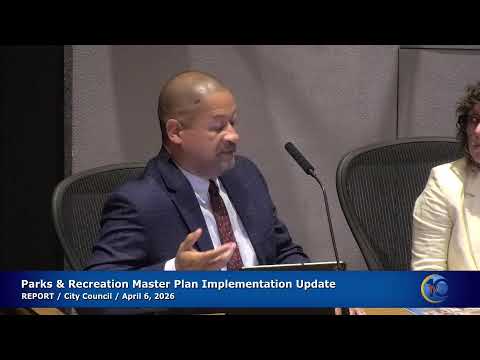
Ri Anthony, the city’s parks and recreation director, presented an update on the department’s newly adopted 10‑year master plan and its implementation priorities.
"We have over 2,000 acres of parkland," Anthony said, outlining the department’s portfolio of pools, playgrounds and trails and saying the master plan identifies roughly $78 million in capital needs over the next decade while current maintenance funding is about $5.5 million a year.
Anthony described three implementation buckets: reinvestment (facility repairs and restroom renovations), enhancement (ADA compliance, playground modernization and systemwide improvements) and visionary projects (major new facilities such as an adaptive recreation center or expanded courts). He said staff are refining a prioritized CIP and coordinating with public works and the budget office to align delivery capacity and funding.
A councilor asked about the Smith Aquatic Center, which has been closed repeatedly; Anthony said HVAC and equipment problems have driven some closures and that staff are evaluating reinvestment needs under the reinvestment bucket. On timelines, Anthony said smaller, high‑impact projects can move forward more quickly, while larger visionary projects require site selection, funding and community engagement and may take multiple years to reach construction.
Cost‑clarification questions surfaced during the presentation: Anthony confirmed a missing zero in a slide and that the adaptive recreation center figure is $20 million. He also said the department requested $500,000 in the CIP for immediate high‑impact, low‑cost projects such as standardized entrance signage and park furnishings.
Anthony said the department lacks in‑house project managers and will rely on public works support or outside contractors to deliver capital projects; the shortage of staff and available revenue together create the primary bottleneck to faster implementation. Staff are working on an internal dashboard for progress tracking and expect a public project dashboard in the future but provided no firm launch date.
Anthony highlighted partnerships the department currently uses (Bennett Village, community sports organizations and summer leagues) and said staff are drafting a consistent policy for evaluating and accepting partner funding so privately raised money aligns with master‑plan priorities and equity goals.
A council member summarized the fiscal reality: both the ADA and parks plans carry large price tags and implementing them at meaningful speed will require either substantial new annual allocations or reprioritization of other spending. The council then moved into a closed session for legal matters.
Anthony said staff will return with a refined CIP and additional detail to support funding requests to council during the budget cycle.