Get Full Government Meeting Transcripts, Videos, & Alerts Forever!
Get email alerts on the Women In History topic
No spam. Unsubscribe anytime.
Norah O'Donnell spotlights overlooked American women at Library of Congress event
Summary
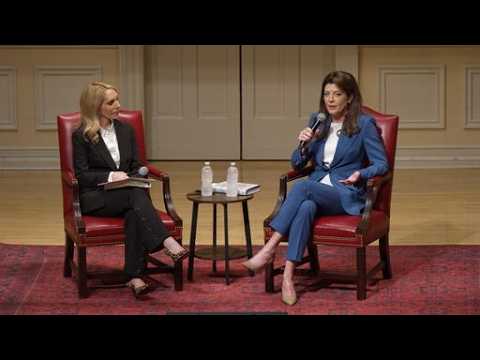
Norah O'Donnell discussed her new book, We the Women: The Hidden Heroes Who Shaped America, at a Library of Congress program hosted by Karen Donfried and moderated by Dana Bash, telling stories of women from Mary Katherine Goddard to Mary McLeod Bethune and urging broader public recognition of their contributions.
Norah O'Donnell, CBS News senior correspondent, described the research and purpose behind her new book, We the Women: The Hidden Heroes Who Shaped America, at a Library of Congress event hosted by Karen Donfried, director of the Congressional Research Service. Dana Bash of CNN served as moderator.
O'Donnell opened by framing the book around the country's Semiquincentennial and an effort to surface women whose contributions have been omitted or minimized in standard accounts of U.S. history. "Now is the time. Now is our moment to recognize the power of women's stories and voices," she said, arguing that a more complete history can change how future generations see possibilities for themselves.
The conversation threaded short biographical vignettes through several historical eras. O'Donnell recounted how Mary Katherine Goddard, a Baltimore printer and postmaster, printed the first official broadside of the Declaration of Independence and placed her full name on the document: "She put her name on that Declaration of Independence for a reason," O'Donnell said, underscoring how women exerted public influence even where the record has downplayed it. She also highlighted Phillis Wheatley, the enslaved poet who tied themes of slavery to revolutionary rhetoric, and Mercy Otis Warren, whom O'Donnell described as a key intellectual force in the revolutionary period.
The program emphasized the recurring pattern of "rejection and redirection," O'Donnell said, telling the story of Elizabeth Blackwell, the first woman to graduate from an American medical school in 1864, who persisted after dozens of rejections. She revisited Civil War-era examples such as Anna Dickinson, whom O'Donnell described as the first woman to speak before the U.S. Congress, and Mary Edwards Walker, a Civil War surgeon who later received the Medal of Honor and, according to O'Donnell's account, resisted efforts to have it removed.
O'Donnell also discussed 19th- and 20th-century figures who worked behind the scenes of celebrated achievements. She recounted Katherine Wright's managerial and public-relations support for her brothers' work on powered flight and Emily Warren Roebling's role in completing the Brooklyn Bridge after her husband's incapacitation. O'Donnell told the audience that these stories are often "buried" in popular accounts and argued for greater public recognition, including plaques and renewed historical attention.
Turning to the more recent past, O'Donnell highlighted political breakthroughs such as Pat Schroeder's congressional career and the impact of Title IX on women's opportunities in sports and education. She placed those gains in an economic frame, citing a figure from her book that a major intergenerational wealth transfer — about $54 trillion — is expected, and noting that "12% of the world's billionaires are women," using those data points to ask how financial power might reshape gender dynamics in the coming decades.
Throughout the evening, Dana Bash guided the conversation with contextual questions and drew on personal recollections of covering the same beats as O'Donnell. The program included recorded clips and applause but, by prior announcement, did not include an audience Q&A. Pre-signed copies of O'Donnell's book were made available for sale after the event.
The program closed with mutual thanks and applause. No formal policy or institutional action was proposed or taken during the event.