Get Full Government Meeting Transcripts, Videos, & Alerts Forever!
Get email alerts on the Zoning topic
No spam. Unsubscribe anytime.
Signal Mountain council holds first reading of zoning changes after residents urge delay
Summary
Residents and long-time property owners urged the Signal Mountain Town Council to slow consideration of a zoning amendment that would raise minimum lot sizes in low-density and residential estate zones; council approved a first reading and scheduled a May 4 public hearing.
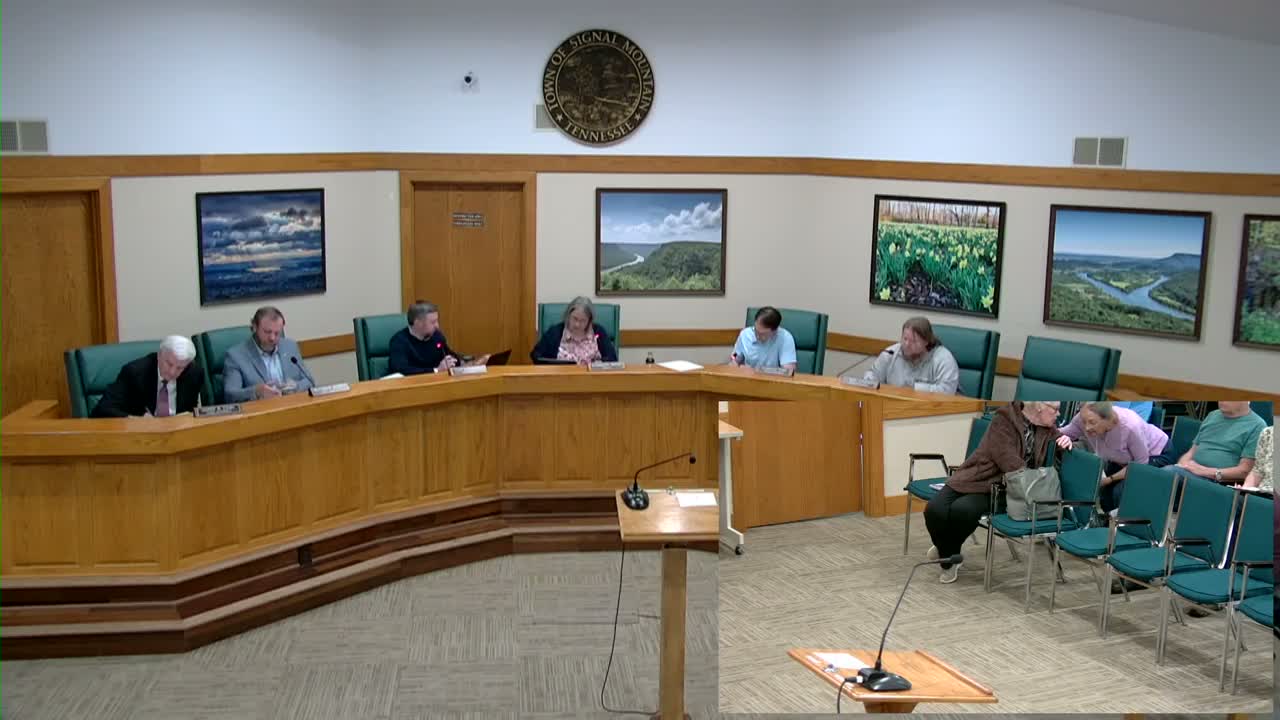
Signal Mountain’s Town Council on April 13 held a first reading of proposed zoning amendments that would raise minimum lot sizes in some low-density residential categories, after more than a dozen residents urged the council to slow the process and gather more public input.
The ordinance amendment—discussed at length during citizens opportunity and again when the council opened the ordinance—would change the density multiplier in some subdivisions to 0.2, which staff said equates to a 5-acre gross density lot. Council members said the change is intended to prioritize infill development and protect strained local infrastructure, while residents and property owners said a tenfold decrease in allowable density would have drastic impacts on land values and land-use plans.
“Can I pause you for a second? … You have a minute and a half,” Mayor Elizabeth Baker told one public commenter who had exceeded the three-minute comment period. Residents used the public-comment period to raise process and notice concerns: Ellie Hill said the Planning Commission meeting lasted about 30 minutes and “those studies weren’t addressed at these meetings,” and she asked the council to ‘pause.’ Jay Bell said a sudden change to a 5-acre minimum would “virtually make your land unusable.”
Council members defending the change pointed to the town’s most recent land use plan (2018) and to infrastructure constraints. A council member who led the ordinance discussion said the town faces safety and capacity risks if larger developments continue without concurrent infrastructure improvements: “We’re about to put 106 homes on septic. That to me is a problem that needs to be addressed,” the council member said, arguing the proposal is part of aligning ordinance language with the land use plan.
Council voted to amend a drafting error in the ordinance language (changing a reference from “conservation” to “conventional” subdivision in one subsection) and approved the ordinance on first reading by voice vote. The council emphasized this is only the first reading: state law requires a 21-day notice and a second reading that will include a public hearing scheduled for May 4 at 5 p.m. in the council chambers.
Several residents and speakers who served on past planning efforts urged the council to allow a more extended, collaborative process before any final vote. Tom Baird, who said he participated in the town’s original land-use plan development, told the council that nowhere in that plan did he see language supporting a 5-acre minimum and warned that such a change could eliminate typical subdivisions.
Council members also raised related concerns, including stormwater runoff and school capacity. Staff and council repeatedly noted that some aspects—septic system limitations, traffic-rated roads, and school impacts—will involve external stakeholders (county and state agencies) or additional technical analysis.
Next steps: after the 21-day public-notice clock, the council will hold a public hearing and second reading at a special-called meeting on May 4 at 5 p.m. The council said the Planning Commission and public will continue to have opportunities to review and refine any final ordinance language.