Get Full Government Meeting Transcripts, Videos, & Alerts Forever!
Get email alerts on the Utilities Rates topic
No spam. Unsubscribe anytime.
Consultant: Master meters cut Highland Park wholesale bills by about $967,000; council presses for CSO reallocation
Summary
Utility Financial Solutions told Highland Park leaders that new master meters reduced wholesale water and sewer charges by roughly $967,000 annually and identified a possible further $339,000 reduction in combined-sewer-overflow (CSO) allocations if a regional reallocation succeeds; council members pressed staff to pursue contractual and legislative fixes for nonpaying parcels and approved a $3 million sewer loan on the agenda.
At a workshop presentation, Mark, a consultant with Utility Financial Solutions (UFS), told Highland Park council members that installation of master wholesale water and sewer meters produced nearly $1 million in annual wholesale savings and that a planned regional review of combined-sewer-overflow (CSO) allocations could yield substantially larger relief.
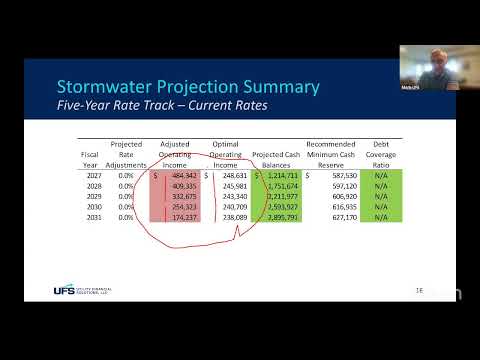
UFS updated the city's five-year financial projection for water, wastewater and stormwater services and recommended no rate increase this year, primarily because the newly captured meter data reduced the city's wholesale charges. "Because of the installation of the wholesale meters, our charges from the wholesaler are actually going to decrease to about $5.4 million — a savings of roughly $967,000 a year," Mark said during the presentation.
The nut of the matter, he said, is CSO allocation. "The allocation established in the late 1990s was never updated," Mark said. Based on recently accepted meter data, UFS estimates Highland Park's allocated CSO share may be closer to 4% rather than the roughly 2.065% currently assigned. Using those figures, Mark said Highland Park's 2027 wholesale CSO-related charges projected at about $1.8 million could instead be roughly $1.5 million — a reduction on the order of $339,000 — if allocations are adjusted.
Kathy Square, who spoke on behalf of the city's recent filings, said the city submitted a two-year progress report to the One Water Partnership in October and that suburban communities convened a committee to press for allocation adjustments. "We have a full expectation that we will get a reduction for the current year and for the future year," Square said, and she noted another committee meeting was scheduled later in the week.
City finance planning still faces constraints. Mark told the council that, even with the wholesale savings, the three operating utilities should hold combined minimum cash reserves of about $3.7 million; current projections without further relief show reserves near $1 million by the end of next year. "If everything stays the same, we're going to have to do something with rates next year without some form of rate relief from the wholesaler," he said.
Council members pressed staff on how the analysis treats large unpaid users and government-owned parcels that do not pay stormwater or utility fees. One council speaker cited an 83-acre parcel (referred to in the discussion as the Model T factory) and the state and county land-bank parcels as drivers of unpaid charges that ultimately burden other customers. The rate analyst responded that ratemaking typically treats those nonpayments as bad debt expense in the model but said UFS could add suggested contractual or legislative steps to the report for the city to pursue. "We can definitely add that in our report," Mark said.
The consultant also ran sensitivity scenarios showing how different CSO reductions and customer growth would change rate pressure: a $500,000 CSO reduction would translate to roughly 5% rate relief; $1 million ≈ 11% relief; $1.6 million ≈ 17% relief. Combined with modest customer growth (1%–5% annually) those savings become larger. Mark cautioned that restoring financial stability first — rebuilding cash reserves and funding deferred infrastructure — may limit how quickly rates can decline.
On the council agenda that night was a separate but related financing item: a state-provided low-cost loan of $3 million to make sewer repairs. Damon, who spoke during the workshop, said the planned work will line and rehabilitate aging sewer mains to reduce groundwater infiltration that increases billed volumes: "This $3 million loan will allow us to line and fix several of those areas to keep that out," Damon said, adding that reduced volumes will produce additional savings when wholesale charges are metered.
Mark recommended a revenue-neutral rate-design adjustment to balance the utilities: increase wastewater charges and use the revenue to lower stormwater charges so each utility tracks nearer its optimal operating income. He offered a concrete starting point — a $200,000 reallocation — and said staff could prepare ordinance-level language for the next council meeting if the council directs it.
Council members voiced willingness to accept modest annual increases if overpayments to the wholesaler are corrected and if the city secures tangible reductions through the regional committee. The workshop concluded with staff committing to revise the draft UFS report to add recommended next steps on unpaid parcels and to follow up with the committee and the wholesaler; the meeting recessed at 7:02 p.m.
What happens next: staff and suburban partners will continue CSO-allocation discussions with the wholesaler; UFS will revise its draft report to include contractual/legislative recommendations regarding nonpaying parcels; and the council has a $3 million sewer loan/bond item on its regular agenda for formal approval.