Get Full Government Meeting Transcripts, Videos, & Alerts Forever!
Get email alerts on the Fire Ems Regionalization topic
No spam. Unsubscribe anytime.
Washoe County launches SB 319–mandated regional fire and EMS study; consultants outline scope, timeline and public input
Summary
Washoe County and consulting firms Emergent Global Solutions and Ardennis Solutions launched a public information session for a Senate Bill 319–mandated regional fire and EMS services study, outlining goals, a compact timeline (final report due Dec. 31, 2026), and a public engagement plan while emphasizing the board cannot mandate consolidation or levy taxes.
Washoe County officials and hired consultants on March 19 launched a public information session to begin a regional fire and emergency medical services study mandated by Senate Bill 319. Cadence Matioich, government affairs liaison for Washoe County, opened the meeting and introduced the consulting team from Emergent Global Solutions and Ardennis Solutions and local fire and city officials.
"The bill does not mandate consolidation. Indeed, the bill does not authorize the study board to mandate consolidation," Matioich said, stressing that any decisions about consolidation or new taxes would be made later by the respective local governing bodies and not by the study board itself.
Consultant Rick Martinez described the study's goals as identifying opportunities for regional collaboration, recommending options to improve service delivery, operational efficiency and fiscal responsibility, and producing scenarios for decision-makers. "This is not a critical review trying to find fault," Martinez said. "What it is is looking for ways to enhance the service you already have." He and Reggie Salvador of Emergent Global Solutions said their team includes former fire chiefs and practitioners and that the work will emphasize stakeholder engagement and community culture.
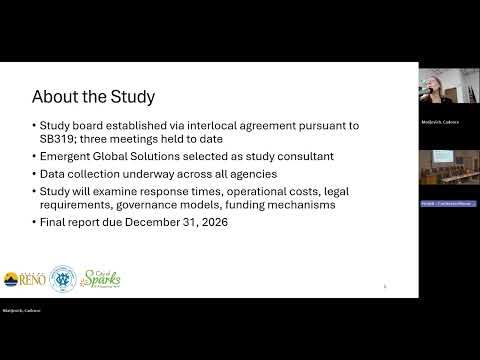
The consultants said their review will cover response times, staffing levels, EMS integration, organizational and governance models, national best practices, and financial impacts—including how any changes might affect insurance costs. Data collection is already underway across local agencies; consultants said they will validate prior studies and produce financial modeling and governance transition options.
Martinez gave a compact schedule: draft deliverables in midsummer, validation in September–October, a study-board presentation in November and final reports to the governing bodies of Washoe County, Reno and Sparks no later than Dec. 31, 2026, as SB 319 requires. He also stressed that recommended options would be presented to the governing bodies, which would decide whether to adopt changes.
The meeting included opportunities for public comment. Tom Dailyaly, speaking for the Estates of Mount Rose, urged caution and warned consolidation could increase property taxes and operating costs for some districts, saying the cost to some property owners could be "about three times higher" for comparable services. Organizers did not counter with specific data during the comment but said the consultants will model financial impacts and funding strategies as part of the study.
Organizers also described public engagement tools: an online landing page and survey (accessible via QR code and a public website), a recorded video of the session to be posted mid-morning the following day, and outreach via the study board website. The consultants encouraged residents to submit data and participate in future meetings as the study proceeds.
The study board was established via an interlocal agreement after SB 319 was signed; Matioich listed study-board leadership and membership at the meeting and named Washoe County Commissioner Marilus Garcia as chair and Joe Rodriguez (Sparks City Council) as vice chair. Martinez emphasized the team's intent to ground recommendations in local context and to model multiple options rather than recommend a single prescriptive solution.
Next steps include continued data collection, public outreach through the posted survey and website, a midsummer draft, and the study-board and governing-body review steps leading to a final report by the statutory deadline.