Get Full Government Meeting Transcripts, Videos, & Alerts Forever!
Get email alerts on the Regional Road Impact Fee topic
No spam. Unsubscribe anytime.
Washoe advisory committee recommends adoption of 8th‑edition regional road impact fee
Summary
A Washoe County advisory committee voted to recommend adoption of an 8th‑edition update to the Regional Road Impact Fee package, which recalculates fees using updated travel‑demand modeling and a revised capital improvement plan totaling roughly $150 million in capacity needs.
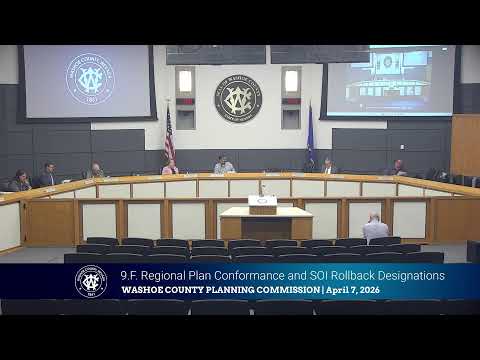
A Washoe County advisory panel on April 7 recommended that the Board of County Commissioners adopt the 8th edition of the Regional Road Impact Fee (RIFF) General Administrative Manual and Capital Improvement Plan.
Jeff Wilch, an engineering manager at the Regional Transportation Commission, told the Capital Improvements Advisory Committee the RIFF update reflects new travel‑demand modeling and a revised project list drawn from the regional transportation plan. "The program allows new development to pay its fair share," Wilch said, describing the fee as a tool that funds capacity improvements but not operations or maintenance.
Wilch said the program’s capital needs rose from about $132 million in the previous (seventh) edition to roughly $150 million in the 10‑year CIP, but the region’s modeled vehicle‑miles‑traveled (VMT) declined, which reduces the per‑unit fee in some land‑use categories. He pointed to several causes for lower VMT estimates — including changes in commute patterns and deliveries — and noted staff updated trip‑generation rates to align with recent Institute of Traffic Engineers guidance and a local household travel survey used by RTC.
The committee also reviewed a business‑impact statement prepared under state law. The statement, Wilch said, concluded the 8th‑edition update is not expected to impose a direct, significant economic burden on businesses; some development types would see modest increases in fees while others would see decreases.
Committee members asked detailed questions about what costs are eligible for RIFF funding and how the fee schedule is calculated. Wilch emphasized RIFF funds pay for capacity improvements identified in the RTP and the RIFF CIP — design and construction of capacity components — and cannot be used for maintenance or operating costs such as signal operations. He also described the program’s shift from a broader credit system toward a more limited waiver framework for offsets.
After discussion, the committee moved to recommend the 8th‑edition GAM, CIP and revised fees to the Washoe County Board of County Commissioners and to authorize the chair to sign a resolution transmitting that recommendation. The motion carried; one committee member voiced opposition during the roll call.
What’s next: the update will be transmitted to city councils and the county board for formal adoption, followed by a 30‑day public notice period. Staff said the new fees and documents are intended to be implemented in June (the presenter referred to "June of '26" in the record). The Board of County Commissioners will consider adoption as the next formal step.
Why it matters: regional road impact fees fund a defined share of roadway capacity projects so that new development helps pay for growth‑related infrastructure. Changes in travel behavior and updated trip‑generation assumptions can materially alter per‑unit charges across land‑use types, producing increases for some categories and declines for others.
(Reporting by Washoe County Planning staff and RTC presentations; motion text and recommendation recorded in the meeting transcript.)