Get Full Government Meeting Transcripts, Videos, & Alerts Forever!
Get email alerts on the Surveillance topic
No spam. Unsubscribe anytime.
Seattle Public Safety Committee recommends passage of two surveillance ordinances, including 60-day pause for CCTV and ALPR
Summary
The Public Safety Committee voted 5-0 on March 24 to recommend passage of CB 121180, aligning city code with the Keep Washington Working Act on immigration-status inquiries, and CB 121179, which creates a mandatory 60-day pause for CCTV and ALPR under specified triggers; both items will go to the March 31 full Council meeting.
The Seattle City Council Public Safety Committee on March 24 recommended passage of two surveillance-related ordinances that the committee and public commenters described as an attempt to balance residents’ privacy with public-safety needs. The committee, chaired by Robert Kettle, voted 5-0 to send both bills to the March 31 City Council meeting.
Chair Robert Kettle opened the meeting by framing the agenda around “ALPR, CCTV” and the city’s broader surveillance program, saying the systems “do not have any facial recognition built into it,” and stressing the need for privacy and data-governance audits before large events such as the FIFA World Cup. Kettle said city and council work has produced multiple ordinances and a surveillance impact process, and described a 60-day pause protocol the bills would formalize if systems are at risk or subject to certain legal requests.
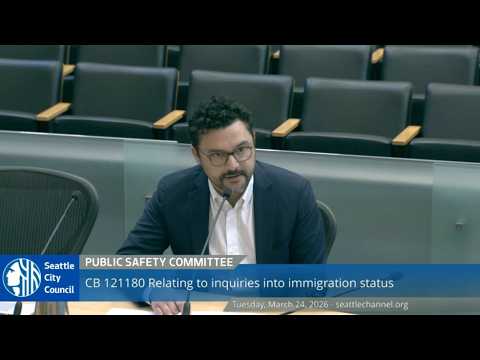
The first item, CB 121180, would amend Seattle Municipal Code section 4.18.015 to align local rules with Washington’s Keep Washington Working Act on when Seattle Police Department personnel may inquire into a person’s citizenship or immigration status. Tamaso Johnson of Council Central Staff summarized the bill and told the committee that enforcement of U.S. immigration law remains a federal function and that the proposed ordinance primarily makes technical changes to conform city code with state law. Johnson noted that SPD operational policy currently limits immigration-status inquiries except by exceptional directive from the chief.
Councilmembers who spoke in support described CB 121180 as a compliance measure that both follows state law and can reassure immigrant residents that they may safely engage with local authorities. Councilmember Lin said the bill “strikes the right balance” between public safety and privacy, and Councilmember Rivera said aligning city code with state law was necessary because “state law is what prevails.” The committee voted in favor; the recommendation to pass CB 121180 will be transmitted to the full Council.
The second item, CB 121179, would extend the same mandatory 60-day pause triggers already used for CCTV to the Seattle Police Department’s ALPR (automatic license plate recognition) systems and add new triggers: when data requests or warrants relate to reproductive-health or gender-affirming-care matters, or when the mayor and police chief jointly determine data may be at risk of disclosure concurrent with increased immigration-enforcement presence. The bill also authorizes the mayor to issue a targeted executive order to temporarily reduce data collection in narrowly defined circumstances to preserve evidence or public safety.
Greg Doss of Council Central Staff summarized both the bill and a recently passed state bill, SB 6002, which requires agencies that use ALPR to register with the attorney general, to delete most ALPR data within 21 days (parking-enforcement data must be deleted within 12 hours), and to prohibit using ALPR for immigration investigations in areas near schools, places of worship, courts and food banks. Doss told the committee that the mayor paused ALPR systems while the city reviews compliance with new state law and that technical changes (for example, vendor geo-fencing from Axon) are expected to implement some SB 6002 requirements.
Sponsors and committee members said the local ordinance is intended to build local guardrails and to preserve the utility of cameras for investigating serious crimes while tightening protections when civil immigration, reproductive-health or gender-affirming-care matters are implicated. Councilmember Rink, the bill’s sponsor, said the measure responds to concerns from impacted communities and civil-rights organizations about data sharing and the potential misuse of surveillance data.
Public comment at the meeting reflected a mix of views. Several residents and business representatives urged keeping cameras active, saying they deter crime and help resolve violent incidents; former councilmember Tonya Will, speaking as a community member and affordable-housing provider, told the committee she and many elders in her neighborhood support cameras to reduce fear. Other commenters warned that surveillance tools have been misused or that privacy protections must be enforced; Gary Lee (a public-safety council member) said he opposed a 60-day pause, arguing it could increase crime in neighborhoods.
Votes at a glance
- CB 121180 (align Seattle code with Keep Washington Working Act; amend SMC 4.18.015): Committee recommendation to pass — moved by Chair Robert Kettle; seconded (not named). Committee vote: Juarez AYE; Lin YES; Rivera AYE; Saka AYE; Kettle AYE. Outcome: recommendation to pass, transmitted to March 31 Council meeting.
- CB 121179 (mandatory 60-day pause triggers for CCTV and ALPR; amend ordinances 127044 and 127297): Committee recommendation to pass — moved by Chair Robert Kettle; seconded (not named). Committee vote: Juarez AYE; Lin YES; Rivera AYE; Saka AYE; Kettle AYE. Outcome: recommendation to pass, transmitted to March 31 Council meeting.
What the bills change and next steps
CB 121180 mainly updates city code language to conform with state law on immigration-status inquiries and clarifies that SPD operational policy currently restricts routine immigration inquiries. CB 121179 formally ties ALPR to existing CCTV pause triggers, adds reproductive-health and gender-affirming-care triggers, and incorporates mayoral executive-order authority to temporarily adjust data collection in narrowly defined circumstances. Both committee recommendations move the ordinances to the full City Council on March 31 for further consideration and possible final action.
The committee asked staff to continue coordination with the mayor’s office and vendors to implement technical protections (for example, geo-fencing) and noted ongoing reviews (including an external review referenced by the chair) to ensure practices align with state law and the city’s privacy expectations.