Get Full Government Meeting Transcripts, Videos, & Alerts Forever!
Get email alerts on the Urban Planning topic
No spam. Unsubscribe anytime.
Evanston consultants outline federal "Putting Assets to Work" plan for three city properties and seek public input
Summary
Consultants running Evanston’s federally funded Putting Assets to Work planning grant described options for three city-owned properties (police & fire headquarters, 2100 Ridge/civic center, Noise and Cultural Arts Center), explained financing paths including federal TIFIA loans and public–private partnerships, and invited residents to upcoming meetings and the project website.
Consultants leading Evanston’s federally funded “Putting Assets to Work” (PAW) planning effort presented the program’s goals and public-engagement plan and answered residents’ questions on financing, reuse constraints and outreach.
“We’re here to explain what’s called the Putting Assets to Work program that we are spearheading for the city of Evanston,” consultant Ryan Porter said, noting the project is supported by a U.S. Department of Transportation planning grant the presentation referenced as the IFAC grant. Porter and his team said the PAW work will produce an initial recommended action plan to present to the city council in the fall after several rounds of ward meetings and larger public meetups.
The PAW effort focuses on three city-owned assets: the city’s police and fire headquarters; 2100 Ridge (the civic center and former city hall, which is on the historic registry); and the Noise and Cultural Arts Center. Porter said each building requires a different approach—ranging from a “light touch” of program improvements to a “heavy touch” redevelopment—and that feasibility and community support will guide recommendations.
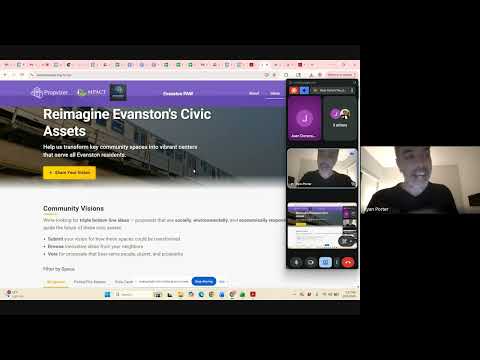
Porter described the engagement process as crowdsourced: residents can post and support ideas at the project website (evstonpaw.org), use on-site suggestion boxes, attend ward meetings and larger public meetups, and take part in breakout sessions. He said the team is asking participants to propose options that meet a triple-bottom-line test of social, environmental and economic responsibility, and that the consultants will screen ideas for feasibility before presenting finalists to the council.
On financing, Porter explained that the DOT planning grant is a first step; completion can make projects eligible for implementation financing programs such as the Transportation Infrastructure Finance and Innovation Act (TIFIA) loans and other federal DOT instruments, as well as tax-credit strategies for historic buildings and public–private partnership arrangements. “Part of our job is going to be to help again figure out the feasibility of the ideas that are supported and then also as part of that feasibility how are they financed,” he said.
Residents pressed specifics. One participant recommended ranking options with ranked-choice methods to surface broadly supported ideas; Porter said ranked-choice voting could be considered after consultants narrow the list to feasible options. Another participant, Rob, asked whether returning city hall to 2100 Ridge had been removed from consideration; Porter said the proposal is listed on the website and remains eligible—its future depends on how much community support it receives and whether feasibility analysis supports it.
A participant who identified herself as Jane, who said she formerly administered federal grants, expressed skepticism about federal grant prospects under the current administration. “I see zero possibility that the Trump administration will approve any grant to Evanston,” she said; that concern went unanswered with a definitive counter from the panel and therefore remained an unresolved risk in the discussion. The consultants noted, however, that TIFIA and other federal financing routes are commonly paired with local public–private strategies and tax-credit financing, which can reduce dependence on direct federal grant awards.
Porter addressed the police and fire headquarters specifically: after several months of technical analysis, he said reuse of the existing headquarters is “not 100% impossible but 90‑something percent” unlikely and that options include relocating those services to a different site or redeveloping adjacent land to keep services in the same area. He said the team is analyzing both relocation and reconfiguration alternatives.
Attendees also raised equity and outreach concerns. Several speakers said that people who can attend meetings so far skew older and white and urged the consultants and council to do targeted outreach with organizations such as Evanston Latinos, senior groups at Fleetwood and other neighborhood institutions; Porter said the team plans ward-specific outreach and site-based meetings and welcomed suggestions for further outreach partners.
Next steps: the team listed upcoming engagement opportunities and materials online. They announced a larger public meetup scheduled for March 25 at Robert Crown (Room D) at 6:30 p.m., additional ward meetings in April and May (including planned larger meetings at Fleetwood and Prito), and ongoing opportunities to post and upvote ideas at evstonpaw.org. Porter and the team said they would compile public input, perform feasibility analyses, and bring a recommended action plan to the council in the fall for consideration.
The meeting closed with thanks to the presenter and reminders about how residents can contact the team and attend future sessions.