Get Full Government Meeting Transcripts, Videos, & Alerts Forever!
Get email alerts on the Municipal Code Updates topic
No spam. Unsubscribe anytime.
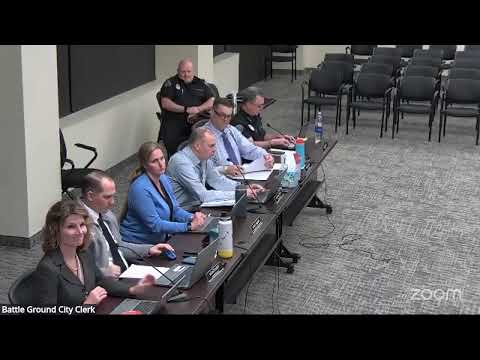
Council reviews broad municipal code update package, including feral-animal rules, sidewalk responsibility and state-driven housing changes
Summary
At the April 6 meeting staff reviewed a multi-chapter municipal-code update: new feral-cat trap/neuter/release authority, proposed rabbit controls, sidewalk and planting-strip responsibility changes, right-of-way/permit clarifications, and state-directed housing code updates (transitional/emergency housing, cottage housing and parking rules). Council asked staff to refine several provisions.
Battle Ground — City staff presented a comprehensive package of municipal code updates on April 6, 2026, covering administrative, public-works, animal-control and land-use topics. Councilmembers probed enforcement burden, equity for legacy homeowners, and the implications of new state housing laws.
Key items presented
- Feral cats and rabbits: Staff proposed enabling trap–neuter–release for feral cats (with partnering organizations covering spay/neuter costs) and new language addressing domesticated rabbits that have been abandoned or become feral. Several councilmembers and residents questioned numeric caps (for example, a proposed limit of five rabbits per lot), urged exemptions for 4‑H/FFA or youth-agriculture programs and recommended focusing on controlling truly feral populations rather than limiting household pets.
- Sidewalks and planter/parking-strip responsibility: The code updates aim to clarify who is responsible for defective sidewalks caused by tree roots or similar growth and to add a process for dangerous sidewalks consistent with risk-reduction guidance. Staff noted that older neighborhoods predate modern root-barrier installation and that abutting property owners currently maintain planting strips unless the city explicitly maintains the strip; councilmembers requested clearer, uniform terminology (e.g., 'planter strip' vs. 'parking strip') and flagged potential cost burdens on property owners who did not plant the trees.
- Right-of-way and C-TRAN items: Proposed language added procedures for annual right-of-way permits, clarified bond and permit-renewal standards, and incorporated C‑TRAN requests to require developers to update transit stops adjacent to new projects so stops meet ADA standards when feasible; councilmembers expressed caution about shifting all ADA upgrade costs to developers without parallel C‑TRAN investments.
- ADUs and sewer connections: The package repeats a 600-foot rule requiring connection to city sewer lines within that distance (consistent with other sections); councilmembers asked staff to clarify the rationale and how the rule applies to large annexed lots currently on septic.
- Housing and GMA-driven changes: To comply with state law, the code adds definitions and allowances for emergency/transitional housing, permanent supportive housing and co‑living, and adjusts parking standards (SB 6015 requires allowing tandem parking and limits on minimum stall size). Planning commission suggestions on cottage housing (increasing maximum unit size to 600 sq ft, raising height limits and considering higher density bonuses) were also presented.
Council reaction and direction
Councilmembers generally supported trap–neuter–release authority for feral cats and agreed the city should be able to respond to problem feral populations, but several asked staff to remove or revise numeric pet caps (e.g., the five-rabbit limit) and to add exemptions for youth agricultural programs. On sidewalks and planting-strip remediation, councilmembers asked staff to review liability and enforcement sequencing so the city and homeowners are treated fairly, particularly in older neighborhoods where trees were planted under developer requirements.
Next steps
Staff will bring refined language back to address council concerns (for example, removing hard numeric caps for rabbits or adding exemptions) and will present the full package at a public hearing scheduled for April 20. Staff also noted some chapters will require more substantive drafting and additional outreach before final adoption.