Get Full Government Meeting Transcripts, Videos, & Alerts Forever!
Get email alerts on the Flood Damage Ordinance topic
No spam. Unsubscribe anytime.
Buncombe County planning board advances flood-damage ordinance amendment to commissioners
Summary
The Buncombe County Planning Board unanimously approved a draft text amendment to the county's Flood Damage Prevention Ordinance (ZPH2026-0000002) and will forward the draft to the Board of Commissioners for consideration in April. The ordinance adds FEMA-based definitions and new restrictions on development and temporary uses in floodways and conveyance shadows.
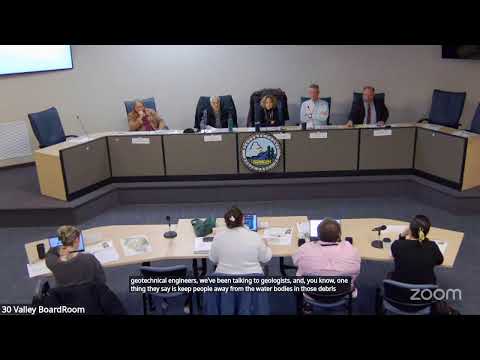
The Buncombe County Planning Board voted unanimously March 16 to advance a draft text amendment to the county’s Flood Damage Prevention Ordinance to the Board of Commissioners for consideration in April.
The board’s action followed a staff presentation by Angela Lee, identified in the meeting as Buncombe County’s floodplain administrator, who walked members through proposed changes to Chapter 34. The draft adds FEMA-based definitions (including conveyance shadow and several types of Letter of Map Change, or LOMC), clarifies the substantial-improvement and variance processes, and tightens standards for floodways and non-encroachment areas.
Why it matters: Staff said the amendments are intended to reduce flood risk by restricting hazardous uses and clarifying review procedures. New restrictions proposed in Section 34-70 include a prohibition on siting new travel trailers or RV parks in designated floodways and non-encroachment areas; a ban on temporary storage of floatable materials (such as mulch, lumber, containers and sheds); a ban on temporary storage of junked vehicles and mechanized equipment; and a prohibition on new development or additions within a defined conveyance shadow.
During public comment, resident De Styles urged the board to examine links between debris flows and steep-slope development, saying homes and roads built on steep slopes have contributed to debris-flow initiation during heavy rain events. “We really need to work on making sure that we don't put ourselves in the position for the next time there's a heavy rain event like we had in 2024 that we're going to have more debris flows,” De Styles said. The concern was echoed by another resident who warned that using fill to raise land could narrow channels and increase downstream erosion.
Staff response: Angela Lee and other planning staff clarified that fill is already prohibited in the floodway and that the draft strengthens floodway standards. They said fill may be permitted in the 100-year fringe where it is studied and reviewed, and staff will consider additional restrictions on fringe-area fill in a later phase. Lee noted that the draft adds a Buncombe-County–specific requirement for LOMRs based on fill: elevated fill must meet the highest regulatory flood protection elevation for the impacted area.
Board action and procedure: After discussion, a board member moved “pursuant to 160D-604” to approve and adopt the public hearing draft ZPH2026-2 as consistent with Buncombe County ordinances and the comprehensive plan; the motion was seconded and passed by voice vote. The chair announced the motion passed unanimously and said the draft will be transmitted to the Board of Commissioners for its April meeting.
What’s next: Staff told the board the ordinance draft will go to the Board of Commissioners at their second April meeting; the county will continue work on related standards and potential future amendments, including possible adjustments to the look-back period for repetitive loss and substantial-improvement calculations.
Authorities and references in the meeting included North Carolina statute 160D-109 (conflict-of-interest rules for appointed boards), North Carolina statute 160D-604 (authority cited for findings/motion), FEMA NFIP guidance (Appendix D) and the Buncombe County Code, Chapter 34 (Flood Damage Prevention).