Get Full Government Meeting Transcripts, Videos, & Alerts Forever!
Get email alerts on the Property Tax Reform topic
No spam. Unsubscribe anytime.
Walton County warns HJR 203 could cut $33 million a year, forcing steep program and capital reductions
Summary
County staff told commissioners that House Joint Resolution 203 — which would eliminate most non-school property taxes on homesteads — could reduce Walton County’s revenue by about $33 million annually beginning in FY2028, imperiling capital projects and non-mandated services.
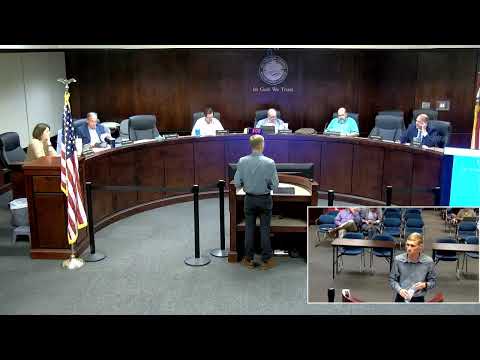
County staff warned commissioners at a Feb. 2026 workshop that a state proposal to eliminate most non-school property taxes for homesteaded properties would sharply reduce Walton County’s general fund and force difficult choices.
Devin Payton of the county Office of Management and Budget said the county estimates the proposal under House Joint Resolution 203 would produce a $33 million annual reduction in county revenue beginning in fiscal year 2028. “If the proposed reform is implemented, the estimated impact on the county would be a reduction of $33 million in annual revenue,” Payton said.
The county’s analysis found roughly 77% of current property tax revenue is committed to statemandated or non-reducible expenses, leaving only about 23% for capital projects, board-directed services and community programs. Payton said roughly 61% of county property-tax support goes to the sheriff’s office; the sheriff’s office receives about $101 million in property-tax support in the current budget year. Other mandated obligations include constitutional officers, court-related costs, the medical examiner and shared juvenile detention costs.
That mix of obligations means the county has limited flexibility to absorb the loss without cutting multiple areas. Payton told the commissioners that even eliminating many capital projects would not fully close the gap: capital improvements account for about $17.8 million of current budgets, and other non-mandated items — libraries, parks maintenance and recreational programs — account for smaller amounts.
Commissioners pressed staff for specifics. Miss Thomasson said staff can produce and publish a reviewed list of approximately $77 million in identified reducible expenses for board review. Commissioners raised employment as a potential source of savings, but Payton cautioned that cutting staff would not be sufficient on its own; he offered an example that eliminating 50 positions at an average cost of $80,000 would yield roughly $4 million, well short of the projected shortfall.
Payton also explained a protective provision in HJR 203: counties and cities would be required to fully fund public safety at either the fiscal year 2026 or 2027 level, whichever is higher, meaning some public-safety budgets (including law enforcement, fire and emergency medical services) cannot be reduced below that floor.
The presentation closed with staff urging public input via a brief survey and a promise to post the packet and supporting materials online. Vice Chair Anderson moved to rise and adjourned the workshop without objection.
What happens next: Payton said HJR 203 has passed the Florida House and could be sent to a special session and, if approved, placed on the November ballot as a constitutional amendment (requiring 60% statewide approval). If enacted, the change would be effective Jan. 1, 2027, affecting the county’s FY2028 budget cycle.