Get Full Government Meeting Transcripts, Videos, & Alerts Forever!
Get email alerts on the Education Transitional Kindergarten topic
No spam. Unsubscribe anytime.
Mill Valley officials say community donations could restore Transitional Kindergarten for 2025–26
Summary
District leaders and parent organizers said a community campaign has raised about $1.3 million toward a $1.8 million goal to reinstate Transitional Kindergarten (TK) for 2025–26; officials warned that final board approval, staffing logistics and a funding timeline — including an April decision window — will determine whether the program is offered.
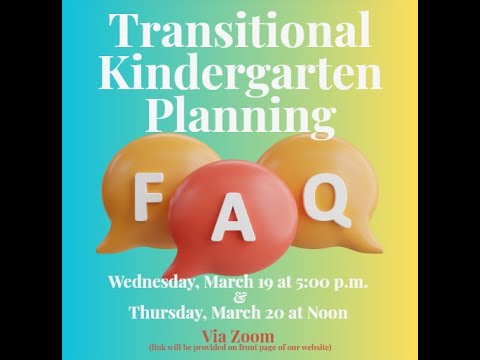
Mill Valley School District leaders and community organizers told families in a recorded webinar that they are close to raising the funds needed to restore Transitional Kindergarten (TK) for the 2025–26 school year but that final board approval and hiring logistics will determine whether the program can proceed.
"I am Elizabeth Kaufman. I am your superintendent," Elizabeth Kaufman said as she opened the session and described how the district would need a board vote to reinstate TK. She said enrollment would open only after a superintendent recommendation and board action so the registration system does not collect families' private information prematurely.
Sid Vanchathan, a parent organizer, described the community fundraising effort and progress. "We were recently adjusting our goal to 1.8 million," he said, adding, "we're almost at 1.3 million with another 500k to go." Michael Burman, who was identified in the attendee list and spoke during the webinar, urged families who cannot give immediately to consider pledging later: "If there's a few of us that are struggling to figure out what that looks like immediately, let's just work as a community to make that come together."
Why it matters: Restoring TK would change staffing needs, classroom placement and the district's budget planning. Kaufman said TK is a full-day, developmentally focused program that emphasizes social‑emotional learning, and that the district aims to staff classes to meet a state-guided adult-to-child ratio.
Staffing, layoffs and hiring timeline District officials warned that staffing choices are constrained by recent personnel actions. Kaufman and other staff explained that the district issued preliminary layoff notices by the March 15 deadline required under education code and that final layoff notices become effective by May 15. Decisions about rehiring would be affected by seniority-based layoff lists and by whether sufficient funding arrives.
"The layoff isn't by credential," Kaufman said, explaining the district's process: preliminary notices in March, with final decisions in May, and that employees retained on the district's roster or on layoff lists could be eligible to return to teach TK if the program is reinstated.
Credentials and class composition Officials described credential differences and classroom staffing: elementary teachers hold a multiple-subject teaching credential and may add early-childhood education (ECE) units; preschool-specific credentials differ from multiple-subject credentials. The district said its TK model would generally be classes of about 20 students staffed by one certificated teacher and one classified adult in order to meet a 1-to-10 ratio.
Placement, enrollment and aftercare Placement of TK classes will be driven by available space at each elementary campus, proximity to bathrooms and hallways, and program balance across sites. Officials said they will try to prioritize siblings where possible but cannot guarantee the same campus for TK and the child's later kindergarten placement.
Kaufman explained the district's enrollment system cannot accept provisional registrations without collecting personal data, so the district prefers to wait to open enrollment until the board acts. Aftercare will be provided through private partners such as Bright Horizons, the city's programs and community providers; the district will publish a site-by-site guide.
Decision timing and next steps Speakers said the community's fundraising timeline could allow the board to consider a special meeting with a 24‑hour agenda window if funds materialize. "Should funding arrive we will have a board meeting — possibly a special meeting — to consider reinstating TK for the 2025–26 school year," Kaufman said; speakers expressed a desire to inform families before spring break if possible.
What remains unresolved Organizers and staff repeatedly stressed that TK's offer for 2025–26 depends on closing the remaining fundraising gap, completing board action and addressing hiring logistics; the district also emphasized that longer-term sustainability for TK in future years remains an unsolved budget issue.
The district plans to post the recorded webinar to its YouTube channel and website and to share next steps and a comprehensive aftercare guide once details are finalized.