Get Full Government Meeting Transcripts, Videos, & Alerts Forever!
Get email alerts on the Parks topic
No spam. Unsubscribe anytime.
Parks master plan lays out 40-plus projects; commissioners debate lighting and funding
Summary
The county’s parks director told the board the 2024 parks master plan recommends more than 40 projects to close service gaps; commissioners discussed how impact fees, voter-improvement funds and CIP dollars could fund priority parks and whether lighting should be eligible for impact fees.
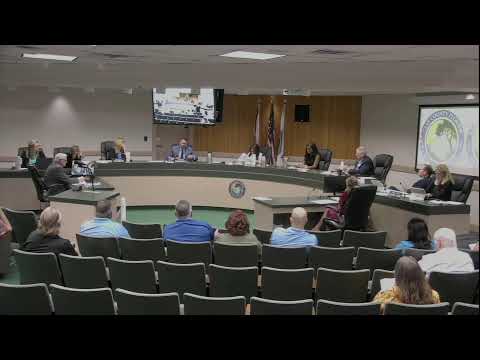
Justin Pierce, director of parks and recreation, presented the county’s 2024 parks master plan and a list of more than 40 recommended capital improvements during the March 10 workshop, telling commissioners the plan identifies district priorities and multi‑year cost estimates.
Pierce said the master plan — adopted in November 2024 — outlines both equity-driven upgrades to existing parks and the need for new community parks to keep pace with rapid county growth. He listed specific priorities by impact-fee district, including Antler Run Park and Marcus Lane in one district, Moccasin boardwalk and the nature center in another, and community-park concepts in Oakleaf and southern Clay County with multi-million-dollar estimated costs.
Commissioners questioned which projects are funded in the current CIP and which remain on the unfunded list. Pierce noted many recommended projects are unfunded and that some design work is occurring but construction dollars are not yet allocated. He said the county has approximately eight years to spend impact-fee revenues after receipt, and that some park projects may need to move forward now to avoid forfeiting district-collected money.
The board also debated whether field lighting is an impact-fee-eligible expense. Staff said the last impact-fee study tied allowable uses to the land‑development code and generally measured capacity in terms of acres/fields; lighting was not included as a capacity increase under that study. Commissioners suggested the board could ask consultants during the next five‑year impact‑fee study (scheduled to begin late summer) to revisit whether lighting or similar upgrades should be considered eligible.
Commissioners and staff also discussed alternatives to CIP funding, including voter-improvement funds and pursuing grants for construction. The parks director said several specific projects (for example, phases of Moccasin boardwalk and Lake Geneva improvements) have preliminary designs but need construction funding.
Pierce’s presentation emphasized that adopting a long-term list without identified funding simply preserves a pipeline of needs; commissioners asked staff to return with budget-ready options and priorities for the June workshop.