Get Full Government Meeting Transcripts, Videos, & Alerts Forever!
Get email alerts on the Public Health Overview topic
No spam. Unsubscribe anytime.
Ulster County health director outlines staffing rebuild, lead response and preparedness plans
Summary
Dr. Walter told the Health, Human Services and Human Rights Committee the Ulster County Health Department is rebuilding nursing capacity, plans to resume home visits for high‑risk births, will restore local STI and TB services, and is expanding lead‑testing and emergency preparedness work.
Dr. Walter, director of public health for Ulster County, told the county Health, Human Services and Human Rights Committee on Feb. 6 that the department is focused on rebuilding core services and restoring public trust after the strain of the COVID‑19 pandemic.
"We’re building up" nursing staff, Dr. Walter said in a department overview, and the county plans to reinstate home visits for high‑risk births once staffing stabilizes. The department has also been working to bring sexually transmitted infection and tuberculosis clinic services back in‑house after relying on external partners during COVID shortages.
The presentation outlined the department’s statutory responsibilities under state public health law and broke the agency into operational divisions: patient services (including adult and child immunizations and home‑visit programs), Women, Infants, and Children (WIC) nutrition services and SNAP enrollment support, environmental health (permitting and inspections for food service, pools, water and septic systems), medical examiner functions, health promotion and chronic disease prevention, and emergency preparedness.
On lead exposure, Dr. Walter described two response tracks: a preventive testing arm that requires owner or renter permission to test homes reported as suspect, and a regulatory pathway triggered when a child’s blood lead level exceeds five micrograms per deciliter. "If a child has a lead level that's over five, regulatory jumps right in immediately," she said, describing follow‑up testing, work plans and oversight until a child’s blood lead level falls below five.
Dr. Walter outlined environmental‑health responsibilities that include inspections of restaurants and temporary food vendors, oversight of migrant farmworker housing and mobile home parks, and permitting and inspection of municipal water systems. She also described discrete services the department provides, including rabies testing in a local lab and voluntary tick testing, while cautioning that a positive tick test does not mean a person is infected and advising symptomatic residents to seek medical care.
In enforcement, she said the county conducts undercover compliance checks to prevent underage tobacco and illegal flavored‑vape sales and uses a graduated process of informal and formal hearings when violations are found; she noted the board of health limits the director’s ability to reduce fines.
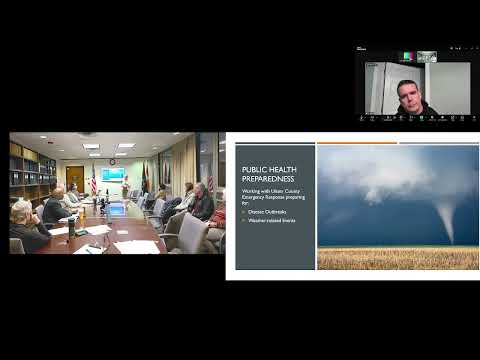
Dr. Walter said the department is prioritizing coalition work and community messaging—citing a heart‑health coalition and a broader Healthy Ulster County effort—and plans to emphasize a "Healthy at Every Size" framing for prevention and public education campaigns. She described emergency‑response planning for events such as fires, floods and power outages, including strategies to help residents preserve medications during outages.
The director also discussed the county medical examiner’s role in investigating unexpected deaths and said autopsies are currently performed at Westchester Medical Center.
The presentation closed with a call to increase public understanding of what local public health does and to build trust: "A COVID took a real toll on how people think about public health," she said. Committee members followed with questions about opioid work, lead remediation costs and limits on local authority, and the department’s access to federal surveillance data.