Get Full Government Meeting Transcripts, Videos, & Alerts Forever!
Get email alerts on the Charter Review topic
No spam. Unsubscribe anytime.
Santa Clara planning commission studies role in citywide charter review; staff flags Aug. 7 filing deadline
Summary
At a March 11 study session, the Santa Clara Planning Commission heard from City Attorney Glenn GooGans on proposed charter updates to modernize budgeting, procurement and boards-and-commissions rules, and discussed how and when the commission should submit formal input ahead of an Aug. 7 registrar filing deadline for the Nov. 2026 ballot.
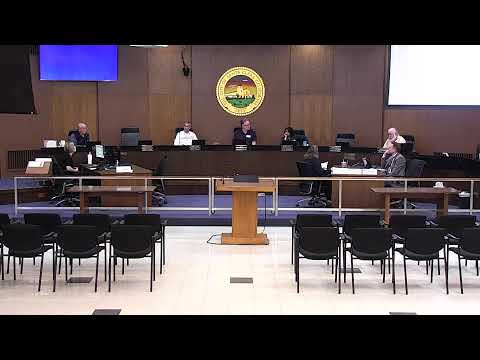
The Santa Clara Planning Commission on March 11 held a study session on the city's charter review project, hearing a presentation from City Attorney Glenn GooGans about proposed updates to Article 10 and other sections that affect boards and commissions, procurement and budgeting.
"The city charter is in effect the equivalent at a local level of the city's constitution," GooGans told commissioners as he outlined why the charter's 1951 language needs revision to align with current law and municipal practice.
GooGans described areas where the charter is out of date and places where the commission could advise changes. Examples included budgeting (the charter's annual-budget language conflicts with the city's current two-year budget practice), an antiquated $1,000 public-works threshold (noted in the presentation as effectively much higher today), and procurement constraints that limit use of design-build delivery for large, complex projects. "Design-build'doesn't make sense for every project," he said, "but for large infrastructure work it can offer value engineering and schedule advantages."
Why it matters
The charter review project is a citywide effort led by a 13-member Charter Review Committee (CRC) dividing the charter into six ad hoc subcommittees. Staff said the objective is to assemble a comprehensive amendment that the city council could place on the November 2026 ballot; final paperwork must be submitted to the county registrar by Aug. 7 to meet that schedule.
Commissioners were asked to focus their comments on Article 10's sections that define the planning commission's composition, powers and duties. GooGans read the current charter language describing the commission's responsibility to "recommend to the city council the adoption, amendment or repeal of the general plan" and urged alignment between charter text and the municipal code so responsibilities are clear.
Discussion and questions
Commissioners asked a range of practical questions: should membership remain seven "qualified electors" or be broadened to residency-based appointment; whether charter language should require particular qualifications or a diversity of backgrounds on advisory bodies; and how to preserve flexibility so the charter does not become obsolete as technology and procurement practice evolve.
On Measure R, a voter-approved charter provision that restricts changing the use of certain park properties, commissioners asked whether limited ancillary uses ' such as siting telecommunications equipment ' could proceed without another citywide vote. GooGans said the provision is being reviewed but cautioned that material changes could require council action and would likely need voter approval. "The only people that have to review it are the voters," he said.
GooGans and staff emphasized a layered approach: include broad, durable principles in the charter (for example, principles about procurement or notice practices) while leaving the operational details to ordinances and administrative policy so the city can respond as practice and technology change.
Next steps for the planning commission
Staff asked the commission to decide how it wants to provide input: designate commissioners to attend the Group 4 (boards and commissions) subcommittee meetings, submit written comments, or agendaize a deeper discussion by the commission. Staff recommended providing input as soon as practical so the CRC can consider planning commission recommendations in time to meet the Aug. 7 registrar deadline if council chooses to place amendments on the November ballot.
Commissioners and staff agreed to attempt to agendaize further commission discussion at the next available meeting (staff suggested April 8), and staff invited commissioners to send proposed topics and draft language in advance.
Votes at a glance
- Motion to excuse Commissioners Botnaggar and Buchini: moved, seconded, passed (vote tally not specified in the transcript). - Motion to approve minutes of Feb. 11, 2026 (consent calendar): moved, seconded, passed (vote tally not specified). - Motion to adjourn to April 8: moved, seconded, passed.
What to watch
If the council elects to place a comprehensive amendment on the Nov. 2026 ballot, the registrar's filing deadline of Aug. 7 means substantive input from boards and commissions will need to be formalized in the coming weeks. Key topics where staff asked for planning commission input include: whether membership qualifications should be revised (e.g., residency vs. qualified elector), whether to expand charter language to explicitly permit procurement methods such as design-build, and how to modernize notice and other procedural provisions to account for evolving technology.
Staff and the city attorney invited commissioners to organize a short, focused agenda item for a future meeting to provide the CRC with written recommendations or a designated representative.
(Reporting for this article relied exclusively on the March 11, 2026 Planning Commission study session presentation and question-and-answer exchange.)