Get Full Government Meeting Transcripts, Videos, & Alerts Forever!
Get email alerts on the Data Center Proposal topic
No spam. Unsubscribe anytime.
Leavenworth County panel on proposed data center draws sharp local opposition and agency reassurances
Summary
Residents urged the Leavenworth County Commission to block a proposed hyperscale data center, citing water, noise and community character risks. State economic-development and utility officials said new tariffs, background screening (SB98), and contractual safeguards are intended to protect ratepayers and limit taxpayer risk.
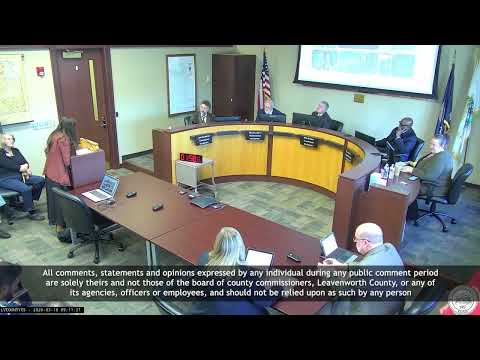
A packed Leavenworth County meetingroom heard hours of public comment and a state-industry panel on March 25 after residents used the public-comment period to press the commission over a proposed large data center near Tonganoxy. Speakers repeatedly warned that the facility could strain local water, raise electric costs for residents, and change the county’s rural character.
“Data centers are among the most intensive facilities in the modern economy,” said Jim Kroskin, a Tonganoxy resident and former state legislator, arguing they can consume “10 to 50 times more electricity than a typical commercial building in Kansas” and warning that water and power costs could fall on local families and schools. Dozens of other residents echoed that view, raising concerns about light and noise, tourism impacts and the prospect of long-term infrastructure liabilities if projects fail.
State and industry panelists urged the county to weigh technical details before acting. Paul Hughes, megaproject business-development coordinator at the Kansas Department of Commerce, said Kansas infrastructure improvements and passage of Senate Bill 98 have made the state attractive to data-center investment, but emphasized communities should use available tools. “As a community, you may want to consider leveraging that [background-screening] tool as a part of how you assign local incentives,” Hughes said, referring to the SB98 requirement for security and operator screening.
Utility and regulatory representatives detailed how they seek to isolate local ratepayers from most of the cost. Chuck Kasley, executive vice president for utility operations at Evergy, described a new large-load tariff the company and regulators negotiated for customers above a 75-megawatt threshold. Under that framework, Kasley said, large users must post collateral, sign long-term contracts and pay a premium so that “direct costs only to serve that customer are borne by that customer.” He added Evergy would not serve projects that “jeopardize the electrical grid.”
Justin Grady, director of the Kansas Corporation Commission’s Utilities Division, explained the settlement process that produced the tariff and described demand-focused billing and minimum-bill provisions meant to capture the cost of new generation and transmission. “The reality is a 600-megawatt data center is going to pay a power bill every month as if they’re using 480 megawatts or not,” Grady said, describing the take-or-pay structure and the collateral and credit standards intended to avoid stranded costs on other customers.
Developers said they aim to reduce community impacts and work with local officials. Aaron Bilu, chief development officer at Cloverleaf Infrastructure, described the firm’s approach to siting, landscaping and community benefits, saying the company will not ask local governments to sign nondisclosure agreements and will prioritize sites that reduce visibility and sound. He also said Cloverleaf intends to use closed-loop, low-water cooling that requires only an initial fill and minimal maintenance water — a point several residents and environmental advocates tested during the hearing.
Environmental and public-health advocates urged stricter local safeguards. Zach Pastor of the Sierra Club said the county should demand water-stewardship plans, prohibit diesel backup generators that produce particulate pollution, require transparent public disclosures of water and energy use, and consider community benefit agreements to offset local impacts.
What’s next: commissioners did not vote on any data-center permits at the meeting. Panelists encouraged the county to request cost-benefit analyses, to use the SB98 screening process before granting local incentives, and to include enforceable commitments (water use limits, emissions standards, collateral or site-reclamation bonds) in any development or conditional-use agreements. The Commission said it will accept follow-up written questions from the agencies and continue public engagement before any formal zoning or permit action.