Get Full Government Meeting Transcripts, Videos, & Alerts Forever!
Get email alerts on the Dmv Hybrid Model topic
No spam. Unsubscribe anytime.
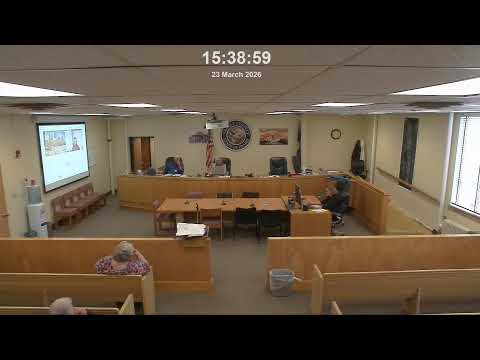
Valley County commissioners agree to pursue ITD ‘DMV hybrid’ model, request staffing and space plans
Summary
After an Idaho Transportation Department presentation on remote services and kiosks, commissioners voted to move forward with a DMV hybrid model for Valley County, asking staff to return with job descriptions, remodel plans or contract buy‑out cost estimates and a training timeline.
Valley County commissioners voted on March 23 to pursue an Idaho Transportation Department (ITD) DMV hybrid model after a presentation on the agency’s push to move more transactions online.
ITD D&B administrator Lisa Mlelen told the board that DMV’s guiding principle is “skip the trip,” and that remote and online transactions have grown from under 300,000 in 2016–17 to more than two million in 2025. The department outlined technologies that reduce in‑office visits — kiosks, a dealer portal for online title processing, remote photo uploads for license renewals and online knowledge testing — and said those changes will affect county foot traffic and revenue.
The presentation assessed local demand and operations for Valley County. “When we ran the numbers for Valley County, we did 14 months worth of data … it looks like 9,000 transactions,” Mlelen said, and ITD recommended three cross‑trained agents to staff a hybrid office: “Two was the break even. Three is because you never want to be out an extra person in case something happens.”
Commissioners and county staff questioned which elected office would manage the consolidated services and how concealed weapons permits (CWP) and other sheriff’s‑handled functions would be sustained. ITD said most hybrid models it has helped implement are administered by the assessor’s office, but a sheriff‑run model is possible and some counties keep CWP processing in the sheriff’s office while driver license photos and issuance occur at the hybrid location.
Officials also discussed logistics at the county annex, where the motor vehicle operation is currently under contract with a private vendor (Ziply). County staff said the contract still had roughly six months remaining and described two options: buy out the contract to move operations sooner, or complete a courthouse remodel first and let the contract lapse. Commissioners asked for engineered plans and an RFQ so bids can be solicited for a remodel if the board chooses that route.
Commissioner discussion emphasized constituent access and continuity of service. After questions and planning points were raised, a commissioner moved “that we go forward with the ITD DMV hybrid model,” the motion was seconded and the board proceeded with a voice vote in favor.
Next steps the board requested include: drafting a job description and budget language for any new position; estimating contract buyout versus remodel costs; a training plan using ITD’s LMS and on‑site assistance; and a public communications plan to inform residents where to go for motor vehicle and driver license services.
Implementation details — which office administers the service, how administrative fees are appropriated between county cost centers, and where concealed‑weapons administrative functions remain — remain subject to the county’s staffing and budget decisions. ITD staff offered hands‑on training and monthly remittance of statutory transaction fees to counties that participate in dealer‑portal processing.
The board did not set a firm start date in the meeting; commissioners asked staff to return with cost estimates and remodel plans for a future agenda item.