Get Full Government Meeting Transcripts, Videos, & Alerts Forever!
Get email alerts on the Election Integrity topic
No spam. Unsubscribe anytime.
Senator from Utah defends Save America Act, says it will not disenfranchise voters
Summary
On the Senate floor the senator from Utah defended the Save America Act’s voter ID and proof-of-citizenship rules as narrowly tailored measures to protect federal elections, tying the bill’s effectiveness to state data-sharing with DHS and disputing critics’ claims that it would disenfranchise large numbers of Americans.
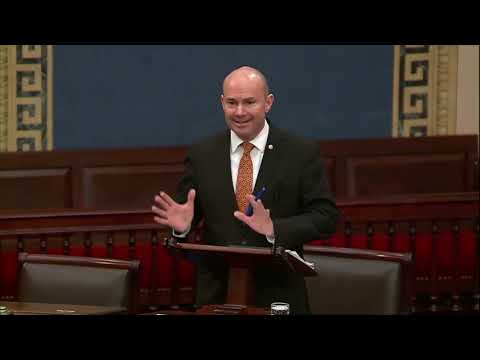
The senator speaking from the floor, identified in the transcript as the senator from Utah, urged passage of the Save America Act on the grounds that it would protect the right to vote by ensuring only U.S. citizens cast ballots in federal elections. "This legislation, once it becomes law, will not disenfranchise a single American citizen, not a single one," the senator said, defending the bill's twin goals "to make it easy to vote and we want to make it hard to cheat."
The senator outlined two principal components of the bill: a requirement that voters show a government-issued photo ID at polling places on election day to verify identity, and a proof-of-citizenship obligation at the time a voter first registers. He said current registrants need not re-register ‘‘unless or until you have some event that requires you to register again,’’ such as moving residence. To address concerns about access, the senator described a flexible list of acceptable documents and a written affidavit process intended to allow people without documentary proof to register; under that approach, a sworn attestation would shift the burden to state election officials to confirm or refute the claim.
The senator repeatedly cited the National Voter Registration Act (NVRA) and the 2013 Supreme Court decision in Arizona v. Inter Tribal Council of Arizona as creating a practical gap in the current system, saying that where applicants register through DMV forms states are limited in following up on suspected non-citizen registrants. He argued that some states refuse to share voter-file data with the Department of Homeland Security’s SAVE database and that the Save America Act’s coordination provisions are intended to address that gap. In the transcript he described this lack of cooperation as a reason the bill is ‘‘necessary.’'
Responding to a frequent criticism — cited by opponents as an estimate that roughly "21 million" Americans lack documents necessary under some proposals — the senator said that number is an overstatement in this context because the bill permits multiple forms of documentation and the affidavit pathway. He emphasized that the bill's affidavit option would let people provide a short sworn statement about their citizenship (for example, birthplace or naturalization details), and that states would then verify those claims. The senator framed the provision as more permissive than routine documentary checks Americans undergo when beginning new employment.
On the floor he also contrasted the Save America Act with the 117th Congress's HR1 (the For the People Act), arguing HR1 would have been a sweeping federalization of state election procedures, while the Save America Act, he said, is narrowly tailored to enforce the existing federal rule that only citizens vote in federal contests. He invoked Article I, Section 4 of the Constitution to justify Congress’s authority to set uniform rules for federal elections.
The senator tied the bill to an unrelated but politically connected item: funding for the Department of Homeland Security. He said that DHS employees and the SAVE database are central to confirming citizenship and that keeping DHS funded is therefore important to enforcement; he criticized continued defunding in the Senate as undermining those capabilities.
A brief exchange on the floor involved Senator Marshall of Kansas, who described problems in the election system as an "illness" and asked about recent state-level proposals to expand non-citizen voting. The senator from Utah said such proposals are unwise and warned that non-citizen participation in local contests creates risks for federal election integrity if voter files are not carefully separated and shared.
The senator used population estimates and contested counts as part of his argument — for example, he attributed figures such as "30 million plus non-citizens residing in this country" and "10 to 15 million" entering unlawfully during recent years to ongoing debate; these numerical claims appear in the transcript as assertions by the senator and are presented here as such, not independently verified.
The senator concluded by thanking Republican Senate leaders, including Majority Leader Senator John Thune, and pledging to continue daily floor work until DHS funding and the Save America Act are secured. "We will not stop until it does," he said.
What this does and does not do: the senator framed the bill as enforcing an existing federal rule that only U.S. citizens may vote in federal elections, adding verification and coordination measures (photo ID at the polls; proof of citizenship at initial registration with a flexible affidavit alternative; state-federal data sharing). He said the bill would not require current registrants to re-register and asserted it would not impose a cost barrier because of the affidavit option. Critics, as recorded in the transcript and summarized above, argue the measures could impose burdens and that provisions elsewhere in the Save America Act are objectionable; those objections are recorded in the broader debate but are not detailed in the senator's floor remarks.
Next steps: in the remarks he urged immediate floor action and linkage of DHS funding and the Save America Act, and signaled he would continue to press the matter on the floor until the measures pass.