Get Full Government Meeting Transcripts, Videos, & Alerts Forever!
Get email alerts on the Reserves Forecast topic
No spam. Unsubscribe anytime.
Larimer County posts un‑audited $81M 2025 net surplus; staff warns revenue caps and disaster exposure could create mid‑term shortfalls
Summary
Budget staff reported an un‑audited countywide 2025 net surplus of roughly $81 million but cautioned that a revenue cap, sliding sales‑tax receipts and potential disaster expenses create a projected structural deficit in 2027–28 before long‑term recovery tied to expiring tax increment financing and certificate payments around the 2030s.
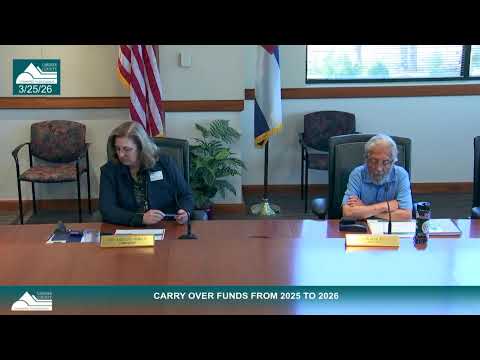
Larimer County budget staff reported on March 25 that preliminary, un‑audited countywide figures for fiscal 2025 show an almost $12 million revenue shortfall offset by about $93 million in expense savings, "netting out to about $81 million total countywide for 2025," according to budget team lead Matthew Bahunan.
Staff emphasized the figures are un‑audited and finance continues to close the books. The presentation broke down the drivers by fund: interest allocation differences and delayed FEMA reimbursements (for incidents such as the Alexander Mountain fire and the 2013 floods) reduced general‑fund revenue in 2025, while personnel vacancy and turnover — notably in human services — produced sizable expense savings.
The budget office presented a multi‑year general fund reserve forecast that incorporates assumptions about revenue and expense growth, no countywide reappraisal this year, and the state's revenue cap that limits property tax growth. Under those assumptions the forecast shows a structural deficit in 2027–28, after which reserves recover later in the 2030s "if we do nothing," staff cautioned, because several urban renewal/TIF districts (named in the session) and a jail‑related certificates of participation series are scheduled to stop diverting revenue to other obligations.
"We are in a structural deficit projected in 27 and 28," staff told commissioners, while explaining that the rebound in the forecast is tied to the expiration of tax‑increment financing diversion and the end of roughly $5.5 million in annual certificate payments around 2034. Commissioners pressed staff on disaster contingency levels, noting that the $5 million disaster contingency could be quickly consumed by a single large incident and that federal declarations — and thus reimbursements — are not guaranteed.
Staff described how emergency response and recovery are managed in real time, with recovery costs sometimes taking years to be reimbursed by FEMA or the state. For planning purposes, the county continues to monitor sales‑tax and property‑tax trends; sales taxes were about 1% below budget for 2025 while property taxes were slightly above estimates. The office also monitors a range of forecasting inputs from state legislative council updates to other research organizations.
Budget staff recommended that commissioners use available reserve capacity to fund strategic, one‑time investments intended to reduce long‑term cost pressure, while continuing targeted reductions to balance ongoing revenues and expenses. Staff outlined next steps including the May target work session and fall 2026 budget development timeline.
The county will finalize audited numbers as finance completes year‑end close; commissioners asked staff to return with refined analyses and to revisit contingency levels and multi‑year tradeoffs as the 2027 budget cycle approaches.