Get Full Government Meeting Transcripts, Videos, & Alerts Forever!
Get email alerts on the Carryovers topic
No spam. Unsubscribe anytime.
Larimer County staff recommend rolling forward select 2025 carryovers, propose investments to save operating costs
Summary
Larimer County budget staff recommended that commissioners approve a subset of roughly $4 million in 2025 carryover requests — totaling about $1.1 million in commission‑direction items and additional manager‑approved rollovers — proposing targeted investments (employee scheduling software, bike parking, a Midpoint fleet fuel site) intended to reduce future operating costs and address service needs.
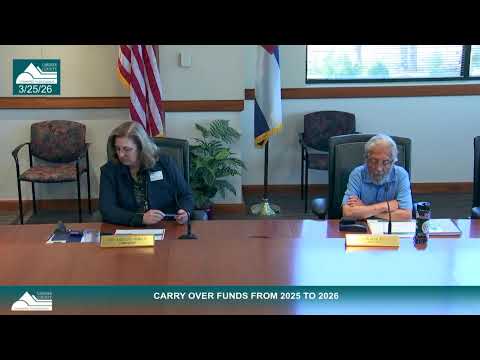
Larimer County budget staff on March 25 outlined roughly $4 million in requested carryovers from fiscal 2025 and recommended the board approve targeted rollovers and investments while deferring or absorbing other requests into department budgets. The work session centered on one-time reappropriations ("carryovers") that move unspent 2025 funds into the 2026 budget.
"This is one-time or leftover funds from the prior fiscal year 2025 to bring them forward into the current year budget 2026," said Matthew Bahunan, budget team lead, as he opened the carryover section. Staff emphasized that the county manager has authority to approve non‑general fund carryovers and restricted accounts under state statute, while new one‑time general fund projects need commissioner direction.
Staff recommended advancing several commission‑direction items: $175,000 for public engagement services to support community outreach; approximately $50,000 in facilities capital interest earnings to install covered bike parking at 200 West Oak and 1501 Blue Spruce; and a $30,000 replacement for an end‑of‑life fingerprinting machine used by Community Justice Alternatives (CJA). Community development requests to digitize microfiche ($75,000) and to carry forward settlement‑derived code‑compliance funds were also recommended.
Two larger operational investments were presented as savings opportunities. Human Resources proposed teles staff scheduling software (one‑time implementation about $388,000 plus roughly $80,000 in ongoing licensing) to reduce overtime in 24‑hour operations (sheriff and CJA). Staff recommended funding the implementation as an efficiency investment. Separately, fleet staff proposed building an internal fuel site near the sheriff's administrative building at Midpoint, which staff estimated could save about $100,000 a year because the county purchases fuel wholesale and avoids commercial‑card fees. Budget staff said they will continue exploring a shared access arrangement with the City of Fort Collins before spending the funds.
Some requests were not recommended at this time. The coroner sought $130,000 for salary adjustments and an additional FTE; staff recommended a zero‑based review during the 2027 budget process before approving recurring positions. Smaller departmental payout requests (retirement payouts), and several projects that appear manageable within existing departmental turnbacks, were recommended to be monitored and re‑addressed in the fall budgeting cycle if needed.
Staff said restricted funds — for example, clerk/recorder e‑recording fees that statute ties to recording technology — are routinely rolled forward when required. For items where reimbursements or external revenues are expected (for example, certain mitigation and emergency response activities), staff recommended waiting to confirm receipts before allocating county general fund carryovers.
Next procedural steps include finalizing manager‑approved carryovers, returning to the board at the May target work session for budget kickoff, and monitoring departments over the summer with potential fall adjustments during the 2027 budget development process.
The presentation and recommendations were framed as investments aimed at reducing ongoing operating costs or addressing outstanding capital/service needs while maintaining caution about creating new ongoing obligations without fuller review.