Get Full Government Meeting Transcripts, Videos, & Alerts Forever!
Get email alerts on the Transportation Safety topic
No spam. Unsubscribe anytime.
Gardner City launches Vision Zero safety action plan after federal SS4A grant; committee maps downtown hotspots
Summary
Gardner City held the first Vision Zero Action Committee meeting after winning a federal Safe Streets and Roads for All (SS4A) planning grant. Consultants presented five years of crash data, identified downtown and corridor hotspots, launched an interactive map for public input, and scheduled public meetings on April 29 and Sept. (second meeting date).
Gardner City convened its inaugural Vision Zero Action Committee meeting to begin a 10–12 month Safety Action Plan funded by a federal Safe Streets and Roads for All (SS4A) grant. Rob Oliva, the city engineer, said the committee will meet about five times and help identify problem locations, recommend priorities and assist with public outreach and implementation.
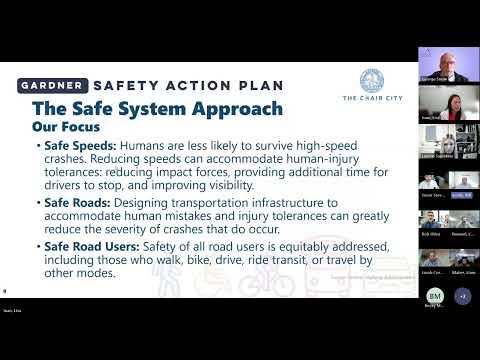
"Vision Zero is that there shouldn't be any fatal crashes, no serious‑injury crashes on our transportation system," said Bill Scully, the Kimley Horn project manager, summarizing the plan's goal and a ‘‘safe‑system’’ approach that combines engineering, speed management, education and post‑crash care. He said the locally focused plan will build on a recent regional action plan and that coordination with MassDOT will be needed for state routes.
The project team presented a five‑year crash review (2021–2025) drawn from the Mass crash portal and other datasets. Lisa Juan, a consultant traffic engineer, reported roughly 2,500 reported crashes over that period (about 500 per year), including 12 fatal injuries and 35 suspected serious injuries — 47 total fatal/serious incidents. She said 2025 so far showed no reported fatalities but an uptick in serious injuries and that the team is periodically updating portal counts.
"We're going to be identifying a high‑injury network," Juan said, noting the plan will examine each street in the city and evaluate countermeasures ranging from striping and signage to curb extensions or corridor treatments. Liam Maher (Kimley Horn) showed maps highlighting downtown clusters and several corridor hotspots: three serious injury crashes on Route 2, three fatal injuries on West Broadway, clusters at the West/Oak/Parker intersection, multiple incidents on Elm Street and several serious and fatal crashes along Route 140. Vulnerable‑user collisions (pedestrians and bicyclists) were concentrated downtown, the team said.
The plan includes a potential demonstration project (for example, curb extensions or shortened crosswalks) to test countermeasures. The SS4A grant requires a self‑certified safety action plan that addresses leadership commitment, data‑driven analysis, prioritized countermeasures, and progress‑tracking; the team said adopting measurable targets will be part of the plan.
Public engagement is central to the effort: the project website features an interactive map where residents can mark crash locations, near misses and propose safety improvements in multiple languages. "We want all of your input — the data shows some things, but lived experience fills gaps," said Liam Maher, describing the comment tool that allows entries, replies and likes.
Committee members discussed distributing flyers at community locations and events; staff noted two near‑term outreach opportunities: the Health and Wellness Fair on May 7 at the Gardner Community Center (Waterford Street, 5–7 p.m.) and a project information session planned for April 29 at 6 p.m. in the community meeting room at the police department. The committee's next (virtual) meeting was scheduled for May 13 at 10 a.m., and the team indicated a second public meeting is planned for September with target plan adoption before the end of the year.
Becky McAffrey (School Health Services Director, Gardner Public Schools), Angela Dep Prima (assistant director of public health), Jason Stevens (director of community development), Dane Arnold (DPW director) and other local stakeholders joined consultants from Kimley Horn to emphasize multidisciplinary input and on‑the‑ground field reviews. The team said it will coordinate with the police and fire departments as it refines crash analysis and conducts field visits.
The project team will circulate the slide deck and a meeting summary on the project website and asked committee members to share the interactive map widely to increase public participation. The committee adjourned after confirming outreach steps and calendar invites would be sent to members.